From its extraction through sale, use and disposal, all the stuff in our lives affects communities at home and abroad, yet most of this is hidden from view. The Story of Stuff is a 20-minute, fast-paced, fact-filled look at the underside of our production and consumption patterns. The Story of Stuff exposes the connections between a huge number of environmental and social issues, and calls us together to create a more sustainable and just world. It'll teach you something, it'll make you laugh, and it just may change the way you look at all the stuff in your life forever.
Story of Stuff, Full Version; How Things Work, About Stuff
Friday, May 27, 2011

Thursday, May 26, 2011
GEORGIA REVOLT - Georgia riot police clear Tbilisi protesters

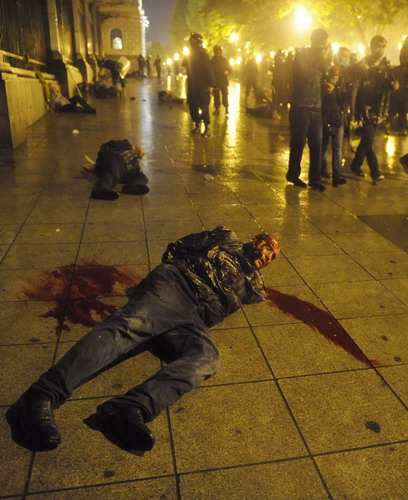
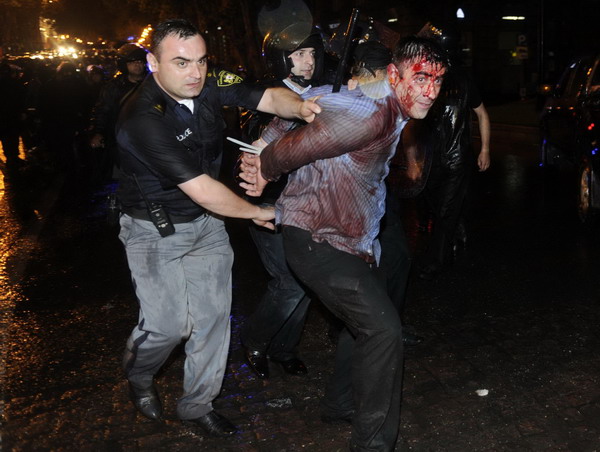
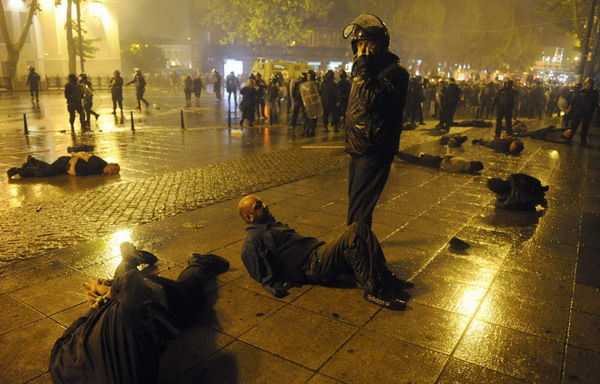
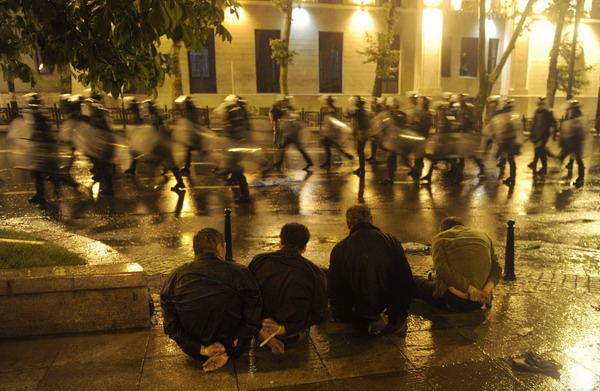
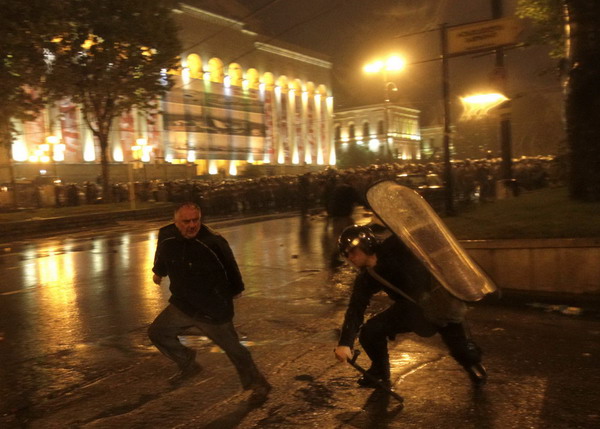
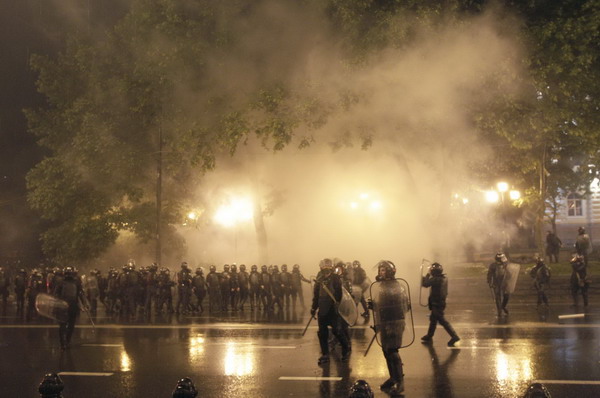
Riot police in Georgia have cleared anti-government protesters from outside the parliament building in Tbilisi.
The police fired tear gas and water cannon at the protesters, some of whom fought back with sticks.
Authorities had promised to clear the protesters ahead of independence day celebrations on Thursday.
Hundreds of people have been demonstrating daily since the weekend, calling for President Mikhail Saakashvili to step down.
The protesters say the president has failed to tackle poverty and accuse him of monopolising power.
'Silver revolution'
Backed by armoured cars firing water cannon, large numbers of riot police arrived from several directions, according to witnesses.
Medics were treating several people with blood on their faces, said Reuters news agency.
The protests began on Saturday, when as many as 10,000 people demonstrated in central Tbilisi. Clashes broke out early on Sunday between police and demonstrators.
The movement has been dubbed the "silver revolution" by some, as many participants are older Georgians, struggling to cope with low pensions and rising food prices, says the BBC's Damien McGuiness in Tbilisi.
But many of the protesters were men wearing scarves or masks to hide their faces, and carrying white sticks, our correspondent says.
Poverty levels are relatively high in Georgia but the opposition is divided and lacks credibility while the Western-backed Mr Saakashvili retains popularity.
The police moved in on the protesters shortly after midnight, as heavy rain fell.
Continue reading - BBC - GEORGIA REVOLT - Georgia riot police clear Tbilisi protesters
Georgia Violence: Video of brutal police crackdown on Tbilisi protests
No Remorse: RT caught in Tbilisi brutal dispersal of Georgia protesters
Wednesday, May 25, 2011
RON PAUL: How to Energize Your Republican Base
On April 25th 2011, Ron Paul went to New York to announce he was starting an exploratory to run for President in the Republican Party. He was met by throngs of supporters. If you want to know how to energize your Republican party -- Ron Paul's message of small government & individual liberty for all is resonating..
RON PAUL: How to Energize Your Republican Base
RON PAUL: How to Energize Your Republican Base
The Hidden Cost of Saving the Euro - ECB's Balance Sheet Contains Massive Risks

While Europe is preoccupied with a possible restructuring of Greece's debt, huge risks lurk elsewhere -- in the balance sheet of the European Central Bank. The guardian of the single currency has taken on billions of euros worth of risky securities as collateral for loans to shore up the banks of struggling nations.
On the green fields near Carriglas, halfway between Dublin and Ireland's west coast, the wind whistles eerily around rows of half-finished houses. Most of these buildings are roofless, leaving their bare walls unprotected against the elements. Even the real estate brokers' for-sale signs and the project offices are gone. Hardly anyone in Carriglas believes that the houses will ever be finished.
There are many of these ghost towns in Ireland, including 77 in small County Longford alone, which includes Carriglas. They could end up costing German taxpayers a lot of money, as part of the bill to be paid to rescue the euro.
That bill contains many unknowns, but almost none of them is as nebulous as the giant risk lurking in the balance sheet of the European Central Bank (ECB), in Frankfurt. Many bad loans have now ended up on that balance sheet, including ones that were used to build houses like those in Carriglas and elsewhere. No one knows how much they are worth today -- and apparently no one really wants to know.
Since the beginning of the financial crisis, banks in countries like Ireland, Portugal, Spain and Greece have unloaded risks amounting to several hundred billion euros with central banks. The central banks have distributed large sums to their countries' financial institutions to prevent them from collapsing. They have accepted securities as collateral, many of which are -- to put it mildly -- not particularly valuable.
Risks Transferred to ECB
These risks are now on the ECB's books because the central banks of the euro countries are not autonomous but, rather, part of the ECB system. When banks in Ireland go bankrupt and their securities aren't worth enough, the euro countries must collectively account for the loss. Germany's central bank, the Bundesbank, provides 27 percent of the ECB's capital, which means that it would have to pay for more than a quarter of all losses.
For 2010 and the two ensuing years, the Bundesbank has already decided to establish reserves for a total of €4.9 billion ($7 billion) to cover possible risks. The failure of a country like Greece, which would almost inevitably lead to the bankruptcy of a few Greek banks, would increase the bill dramatically, because the ECB is believed to have purchased Greek government bonds for €47 billion. Besides, by the end of April, the ECB had spent about €90 billion on refinancing Greek banks.
Former Bundesbank President Axel Weber criticized the ECB's program of purchasing government bonds issued by ailing euro member states. In the event of a bankruptcy or even a deferred payment, the ECB would be directly affected.
But even greater risks lurk in the accounts of commercial banks. The ECB accepted so-called asset-backed securities (ABS) as collateral. At the beginning of the year, these securities amounted to €480 billion. It was precisely such asset-backed securities that once triggered the real estate crisis in the United States. Now they are weighing on the mood and the balance sheet at the ECB.
No expert can say how the ECB can jettison these securities without dealing a fatal blow to the European banking system. The ECB is in a no-win situation now that it has become an enormous bad bank or, in other words, a dumping ground for bad loans, including ones from Ireland.
Continue reading - The Hidden Cost of Saving the Euro - ECB's Balance Sheet Contains Massive Risks
Alan Greespan Admits Ponzi Scheme
Senator Reed asked the sitting Federal Reserve Chairman Alan Greenspan if he still believed that we should maintain the fundamental principles of Social Security?
“I believe that we should maintain the principles of Social Security, but I think the existing structure is not working. Until we construct a system that creates the savings that are required to build the REAL assets, so that the retirees have REAL goods and services. We don’t have a system that is working. We have one that basically moves cash around and we can guarantee cash benefits as far out and whatever size you like, but we cannot guarantee their purchasing power. Do we have the material goods and services that people will need to consume, not whether or not we pass some hurdle with respect to how legal financing occurs. Financing is a secondary issue and it is a means to create the REAL wealth, not an end into itself.” -Alan Greenspan
via Alan Greenspan Admits To Big Ponzi Scheme
Alan Greespan Admits Ponzi Scheme
“I believe that we should maintain the principles of Social Security, but I think the existing structure is not working. Until we construct a system that creates the savings that are required to build the REAL assets, so that the retirees have REAL goods and services. We don’t have a system that is working. We have one that basically moves cash around and we can guarantee cash benefits as far out and whatever size you like, but we cannot guarantee their purchasing power. Do we have the material goods and services that people will need to consume, not whether or not we pass some hurdle with respect to how legal financing occurs. Financing is a secondary issue and it is a means to create the REAL wealth, not an end into itself.” -Alan Greenspan
via Alan Greenspan Admits To Big Ponzi Scheme
Alan Greespan Admits Ponzi Scheme
Sunday, May 22, 2011
MUST WATCH! Ron Paul - Las Vegas, Nevada May 17th, 2011
Ron Paul kicks of his campaign for President in Las Vegas at a Clark County Republican party function. Dr. Paul's message about restoring the principles of Liberty, and Constitutional supremacy in government are resonating more and more with concerned Americans.
Ron Paul Las Vegas, Nevada May 17th, 2011 - Part 1
Ron Paul Las Vegas, Nevada May 17th, 2011 - Part 2
Ron Paul Las Vegas, Nevada May 17th, 2011 - Part 3
Ron Paul Las Vegas, Nevada May 17th, 2011 - Part 1
Ron Paul Las Vegas, Nevada May 17th, 2011 - Part 2
Ron Paul Las Vegas, Nevada May 17th, 2011 - Part 3
Saturday, May 21, 2011
SPAIN REVOLT - Spain protesters defy ban to remain in Madrid square

Tens of thousands of Spanish protesters have defied a government ban and camped out overnight in a square in the capital, Madrid.
The protesters are angry with the government's economic policies and have occupied the square for the past week.
Spain's electoral commission had ordered them to leave ahead of local elections on Sunday.
But as the ban came into effect at midnight, the crowds started cheering and police did not move in.
The protest began six days ago in Madrid's Puerta del Sol as a spontaneous sit-in by young Spaniards frustrated at 45% youth unemployment.
The crowd has grown to some 25,000 in the capital and has spread to cities across the country. Hundreds have camped out each night in Madrid.
They are demanding jobs, better living standards, a fairer system of democracy and changes to the Socialist government's austerity plans.
"They want to leave us without public health, without public education, half of our youth is unemployed, they have risen the age of our retirement as well," said protester Natividad Garcia.
"This is an absolute attack on what little state welfare we had."
Protest growing
Another protester said she was taking part because she had no employment prospects despite having a degree.
"This should make the political classes aware that something is not right," said 25-year old Inma Moreno.
Many of the participants have drawn parallels between their actions and the pro-democracy protests in central Cairo that revolutionised Egypt.
Continue reading - BBC - Spain protesters defy ban to remain in Madrid square
The protests are not really anti-government, but rather anti-big political parties, both the one in power and the main ones in opposition.
It's an anti-capitalism, anti-market ruled society, anti-banks, anti-political corruption, anti-failed democracy, anti-degraded democracy and pro-real democracy protest.
It's a protest that wants a better, real future, not the future that the government or parties in opposition seem to be able to provide.
The manifestos and proposals are quite left-leaning ideologically, but not linked to any political party, because right now, most of us don't feel represented by them.
Continue reading - BBC - Spain protests: 'We want change'
#SpanishRevolution: Medien bericht(et)en spärlich
Wednesday, May 18, 2011
Ron Paul: Why The Young Flock To An Old Idealist

Go to any Ron Paul event and it strikes you immediately: What's up with all the young people?
The 75-year-old Texas congressman packs halls on college campuses. His campaign volunteers often look too young to shave. And even at a recent New York City book signing, it's surprising how many teenagers and 20-somethings are lined up for an autograph, clutching Paul's new book, Liberty Defined.
Sixteen-year-old Rob Gray says the age of the crowd doesn't seem odd to him.
It's "the old canard of the young being more open-minded than the old," he says.
Paul, the world's most unlikely teen idol, is running again for president.
He failed to reach the White House twice before: In 1988, running as a Libertarian, he got less than 1 percent of the vote; in 2008, he made a losing shot at the Republican nomination.
But don't expect the man to reinvent himself. Paul is nothing if not consistent. He still wants to shut down the Federal Reserve; still wants to slash the size of government and bring the troops home. Already in the first Republican primary debate, he restated his long-held belief that drugs should be legalized.
It's a unique set of beliefs for a congressman, but that's why his fans love him.
At the New York City event, the young people keep packing into the bookstore. The line starts in the children's section, moves through self-help and recovery, past the memoirs and along the great ideas bookshelf.
When Paul arrives, he sits down in the World History section, and his bushy eyebrows go up in surprise.
Paul says it still amazes him when kids want to talk about the Federal Reserve.
"When I was in high school and college, at the age many of those young people are now, I didn't have much interest in politics at all," Paul says. "I was probably more interested in trying to get into medical school."
Looking back at his youth, you can see the spark that drove Paul is the same as the one that inspires his fans: a desire for a unified philosophy to make sense of the world.
Continue reading - Ron Paul: Why The Young Flock To An Old Idealist
Everything and Nothing
Two-part documentary which deals with two of the deepest questions there are - what is everything, and what is nothing?
In two epic, surreal and mind-expanding films, Professor Jim Al-Khalili searches for an answer to these questions as he explores the true size and shape of the universe and delves into the amazing science behind apparent nothingness.
The second part, Nothing, explores science at the very limits of human perception, where we now understand the deepest mysteries of the universe lie. Jim sets out to answer one very simple question - what is nothing? His journey ends with perhaps the most profound insight about reality that humanity has ever made. Everything came from nothing. The quantum world of the super-small shaped the vast universe we inhabit today, and Jim can prove it.
BBC - Everything and Nothing - Everything
BBC - Everything and Nothing - Nothing
In two epic, surreal and mind-expanding films, Professor Jim Al-Khalili searches for an answer to these questions as he explores the true size and shape of the universe and delves into the amazing science behind apparent nothingness.
The second part, Nothing, explores science at the very limits of human perception, where we now understand the deepest mysteries of the universe lie. Jim sets out to answer one very simple question - what is nothing? His journey ends with perhaps the most profound insight about reality that humanity has ever made. Everything came from nothing. The quantum world of the super-small shaped the vast universe we inhabit today, and Jim can prove it.
BBC - Everything and Nothing - Everything
BBC - Everything and Nothing - Nothing
Tuesday, May 17, 2011
Stephen Hawking: 'There is no heaven; it's a fairy story'
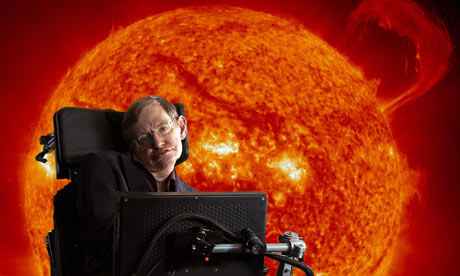
In an exclusive interview with the Guardian, the cosmologist shares his thoughts on death, M-theory, human purpose and our chance existence
A belief that heaven or an afterlife awaits us is a "fairy story" for people afraid of death, Stephen Hawking has said.
In a dismissal that underlines his firm rejection of religious comforts, Britain's most eminent scientist said there was nothing beyond the moment when the brain flickers for the final time.
Hawking, who was diagnosed with motor neurone disease at the age of 21, shares his thoughts on death, human purpose and our chance existence in an exclusive interview with the Guardian today.
The incurable illness was expected to kill Hawking within a few years of its symptoms arising, an outlook that turned the young scientist to Wagner, but ultimately led him to enjoy life more, he has said, despite the cloud hanging over his future.
"I have lived with the prospect of an early death for the last 49 years. I'm not afraid of death, but I'm in no hurry to die. I have so much I want to do first," he said.
"I regard the brain as a computer which will stop working when its components fail. There is no heaven or afterlife for broken down computers; that is a fairy story for people afraid of the dark," he added.
Hawking's latest comments go beyond those laid out in his 2010 book, The Grand Design, in which he asserted that there is no need for a creator to explain the existence of the universe. The book provoked a backlash from some religious leaders, including the chief rabbi, Lord Sacks, who accused Hawking of committing an "elementary fallacy" of logic.
The 69-year-old physicist fell seriously ill after a lecture tour in the US in 2009 and was taken to Addenbrookes hospital in an episode that sparked grave concerns for his health. He has since returned to his Cambridge department as director of research.
The physicist's remarks draw a stark line between the use of God as a metaphor and the belief in an omniscient creator whose hands guide the workings of the cosmos.
Continue reading - Stephen Hawking: 'There is no heaven; it's a fairy story'
Monday, May 16, 2011
Why Ron Paul Is Looking to Run Again
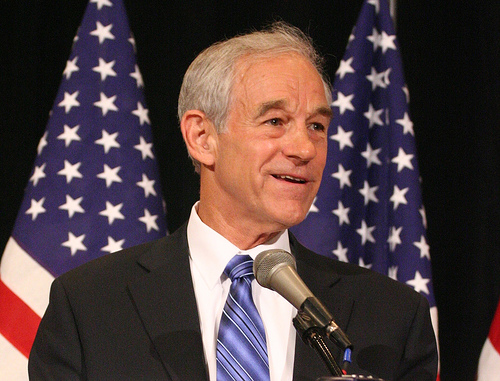
Rep. Ron Paul, the 75-year-old stubborn uncle of the Republican Party, is ready to go again, with his third campaign for President of the United States. He announced an exploratory committee Tuesday afternoon in Iowa, with an eye towards kicking off an official 2012 campaign for President in mid-May. Once again, he plans to be on stage at the first GOP primary debate, this year taking place May 5 in South Carolina, to offer rather un-Republican positions on foreign policy, drug legalization and returning the U.S. dollar to the gold standard.
To hear his people tell it, this is Paul’s moment. “Price inflation and the weakening of the dollar is what Ron has been worrying about for the last 40 years of his political life,” says Jesse Benton, who worked as Paul’s press secretary in 2007, married Paul’s granddaughter in 2008, managed Rand Paul’s 2010 Senate campaign, and is in line to chair Ron’s 2012 effort. “Ron Paul is to be taken very seriously this time.” But should he? In short: yes.
That’s not to say Paul has much of a shot at winning the nomination. Many of his core beliefs remain anathema to the GOP rank and file, with his talk of “world empire” or his support of the Personal Use of Marijuana By Responsible Adults Act. In 2008, a year when expectations were blown away, Paul won exactly 1% of Republican delegates, and was denied an opportunity to speak at the national convention.
But Paul does not operate like other candidates, and need not be judged like them. He is less a leader than a symbol, the eye of an ever-widening hurricane of libertarian discontent that has seized the imagination of young people, fiscal conservatives and others across the county. It was Paul supporters, after all, who began to hold tea parties long before anyone knew what the modern Tea Party was. It was Paul supporters who pushed Congress to pass a bill to force the Federal Reserve to open its books, a once-unthinkable invasion of the Fed’s independence. The Paul-effect, in short, is felt far beyond the ballot box.
Continue reading - TIME - Why Ron Paul Is Looking to Run Again
Ron Paul: I'm Running for President!
College Conspiracy
NIA Releases The "College Conspiracy" Video, Or Why The College Bubble Is Next To Pop
College Conspiracy
College Conspiracy
Sunday, May 15, 2011
IMF Chief Strauss-Kahn Charged With Attempted Rape

Dominique Strauss-Kahn, the head of the International Monetary Fund and a potential candidate for the French presidency next year, was charged with attempted rape and a criminal sex act on a woman in a New York hotel, the police said today.
The charges stem from an incident that allegedly occurred yesterday against a 32-year-old female at a Sofitel hotel in midtown Manhattan, the New York Police Department said in an e- mailed statement early today. Strauss-Kahn was arrested on an Air France flight at John F. Kennedy airport, the police said. He also was charged with unlawful imprisonment.
Strauss-Kahn, 62, denies the charges and will plead not guilty, his lawyer Benjamin Brafman said in an e-mailed statement to Bloomberg News today.
He will appear in a Manhattan court later today, New York Police Deputy Commissioner Paul Browne told BBC television in an interview.
The alleged victim is a maid at the hotel, Browne said, according to the New York Times. The assault occurred about 1 p.m. yesterday when the woman entered the $3,000 a night suite -- Room 2806 -- Strauss-Kahn had checked into on May 13, Browne said, the Times reported.
The maid managed to escape from the room and notified colleagues who called the police, Browne told the Times. When officers arrived, Strauss-Kahn was not there and appeared to have left in a hurry, Browne said. His mobile phone had been left behind, Browne told the newspaper.
European Bailouts
Strauss-Kahn had been scheduled to attend a meeting of euro area finance ministers in Brussels tomorrow. The meeting will take place as officials discuss the possible increase of a 110- billion euro ($155-billion) loan package to Greece amid concerns the country may be unable to return to markets to finance its debt next year.
“For the fund, this is terrible news at a time when its leadership needs to portray stability, wisdom, and confidence,” Bessma Momani, a professor in the department of political science at the University of Waterloo in Canada, who specializes in the IMF and its policies, said in an e-mail.
The IMF “remains fully functioning and operational” following Strauss-Kahn’s arrest, the Washington, DC-based organization said in a statement on its website today.
Immunity?
“Mr. Strauss-Kahn has retained legal counsel, and the IMF has no comment on the case; all inquiries will be referred to his personal lawyer and to the local authorities,” Caroline Atkinson, the director of external relations at the IMF, said in the statement.
New York police said Strauss-Kahn doesn’t have diplomatic immunity. The French Foreign Ministry in Paris said the IMF will have to examine what immunity Strauss-Kahn may have. A French consul visited Strauss-Kahn in detention late yesterday, ministry spokesman Bernard Valero said in a phone interview.
Continue reading - Bloomberg - IMF Chief Strauss-Kahn Charged With Attempted Rape
Ron Paul: IMF Implicated After Chief Arrested on Attempted Rape Charge
The leader of the International Monetary Fund now embroiled in a criminal assault case in New York City was cleared in 2008 of harassment charges after an affair with an IMF economist.
But it's that kind of behavior that should make the world wonder about trusting the IMF, Rep. Ron Paul said Sunday.
The 2008 Republican presidential candidate told "Fox News Sunday" that Dominique Strauss-Kahn, who was pulled off an Air France flight moments before take-off from New York Saturday and arrested on charges of a criminal sex act, attempted rape and unlawful imprisonment, said the whole course of events "is a bit ironic."
Paul, who makes no secret about his disgust of IMF policies, said Strauss-Kahn demonstrates why the Fund has problems.
"These are the kind of people that are running the IMF and we want to turn the world finances and the control of the money supply to them," Paul said. "That should awaken everybody to the fact that they ought to look into the IMF and find out why we shouldn't be sacrificing more sovereignty to an organization like that and an individual like he was."
At the time, French commentators claimed the investigation's timing was suspicious since it coincided with the IMF push toward a global currency.
"It's very odd that it comes just at the moment when people are talking about the IMF and its head taking a lead role in creating a new global financial order which will not necessarily be to the advantage of wealthy, right-wing Americans," a French economist and government adviser told Britain's Observer newspaper.
But Paul said the IMF's moves toward a world currency are "a threat to us."
"I would like to go to a sound American currency, but others want to go to a world currency. They want to use the IMF," he said.
Continue reading - Ron Paul: IMF Implicated After Chief Arrested on Attempted Rape Charge
At Milan's Bourse, Finger Pointing Has Business Leaders Up in Arms

Sculptor Cattelan Made a Rude Statement; Why Not? Wall Street Has a Bull
MILAN—Wall Street's charging-bull statue is the very epitome of financial strength. Outside the stock exchange in Italy's financial capital is an equally unambiguous symbol: a giant marble middle finger.
The 36-foot white sculpture is a hand without fingers except that vulgar one, pointing away from Milan's stock market. It was made by Italy's most famous contemporary artist, Maurizio Cattelan, who donated it to the city last year on the condition that it grace Piazza Affari, or Business Square, where the bourse has its headquarters.
Milan's mayor agreed to it. Now, however, the statue is raising hackles among the city's business and financial establishment. Consob, Italy's stock-exchange regulator, threatened to move its annual meeting, usually held in the stock exchange, elsewhere, lest the fickle finger offend the organization's members. Assogestioni, an Italian asset-managers group, recently moved its conference to a business school.
Stock market Chief Executive Raffaele Jerusalmi says the view from his third-floor office onto Piazza Affari was ruined last year when the statue arrived. In March, he moved to an adjacent wing. "I don't suffer from the finger anymore," he says.
The city's politicians, however, are sticking to their guns, even making the statue part of their electoral platforms ahead of this weekend's local elections.
For conservative Mayor Letizia Moratti, the finger is raising Milan's cultural profile, a goal that is part of her electoral platform. "Milan must be a capital for contemporary art," says city councilman for culture Massimiliano Finazzer Flory, who commissioned the finger and works with Ms. Moratti. The mayor declined to comment.
The city's center-left candidate, Giuliano Pisapia, who is running against Ms. Moratti, also supports the statue as "a free expression of artistic creativity…that shouldn't be censored," he said through a spokeswoman. "It's an open criticism of the international financial management that led to the great crisis of 2008."
Continue reading - WSJ - At Milan's Bourse, Finger Pointing Has Business Leaders Up in Arms
Subscribe to:
Posts (Atom)