If I have seen further it is by standing on the shoulders of giants.

Showing posts with label Open Source. Show all posts

Sunday, May 13, 2012

MUST READ! Better Than Owning | Kevin Kelly

Ownership is not as important as it once was.

I use roads that I don't own. I have immediate access to 99% of the roads and highways of the world (with a few exceptions) because they are a public commons. We are all granted this street access via our payment of local taxes. For almost any purpose I can think of, the roads of the world serve me as if I owned them. Even better than if I owned them since I am not in charge of maintaining them. The bulk of public infrastructure offers the same "better than owning" benefits.

The web is also a social common good. The web is not the same as public roads, which are "owned" by the public, but in terms of public access and use, the web is a type of community good. The good of the web serves me as if I owned it. I can summon it in full, anytime, with the snap of a finger. Libraries share some of these qualities. The content of the books are not public domain, but their displays (the books) grant public access to their knowledge and information, which is in some ways better than owning them.

Very likely, in the near future, I won't "own" any music, or books, or movies. Instead I will have immediate access to all music, all books, all movies using an always-on service, via a subscription fee or tax. I won't buy – as in make a decision to own -- any individual music or books because I can simply request to see or hear them on demand from the stream of ALL. I may pay for them in bulk but I won't own them. The request to enjoy a work is thus separated from the more complicated choice of whether I want to "own" it. I can consume a movie, music or book without having to decide or follow up on ownership.

For many people this type of instant universal access is better than owning. No responsibility of care, backing up, sorting, cataloging, cleaning, or storage. As they gain in public accessibility, books, music and movies are headed to become social goods even though they might not be paid by taxes. It's not hard to imagine most other intangible goods becoming social goods as well. Games, education, and health info are also headed in that direction.

As creations become digital they tend to become shared, ownerless goods. We can turn this around and say that in this realm of bits, property itself becomes a more social endeavor. Property may be less about title and more about usage and control. An idea can't be owned in the way gold can; in fact an idea has little value unless it is shared or used to some extent. Its value paradoxically can increase the less it is owned privately. But if no one owns it, who gains the benefit of that increase in value? In the new regime users will often assume many of the chores that owners once had to do. And so in a way, usage becomes ownership.

According to the principle of dematerialization, all goods are having their atoms infused with bits, decreasing their weight per performance, so that all material goods increasingly behave as if they were intangible services. This means that lumber, steel, chemicals, food, cars, plane flights – everything made – can also be governed by the principles of intangible goods (see the New Rules of the New Economy). As goods become disembodied, infused with slivers of mind, and packed full of bits, they will also obey the new dynamics of property. Soon enough everything manufactured will potentially become social property.

As cars become more "electronic" or digital, they will tend to be swapped and shared and used in a social way. The more we embed intelligence and smarts into clothing the more we'll treat these articles as common property. We'll share aspects of them (perhaps what they are made of, where they are, what climate they see), which means that we'll think of ourselves as sharing them.

Our sense of ownership is a funny thing. If you purchase an ebook and download the book's PDF file to your computer, you'd say you owned it, and expect the rights of ownership. However if you went to a link where a PDF of a book was opened on your screen for free and automatically, you might not feel you owned this book, even if it was copied to your disk. Possession of a copy turns out to be less important in the feeling of ownership than does the price. Free things don't generate strong feelings of ownership. Gifts do, which we think of as "free," but our sense of ownership is related to their "replacement costs" – how much they would cost us to buy elsewhere, their market value. If an item has a marketplace cost of zero, we tend not to feel we own it. So as more economic activity gravitates toward the free, less will feel owned. As more is shared, less will act like property.

Sharing is not very different from renting. We could say that the sharing economy currently emerging from social media is really a renting economy. But we don't use the word "rent" logically. When we watch a movie on a pay-TV channel we are actually renting it, although we don't use that word. Yet in fact we use a movie (movies are used by watching them) without owning it; instead we pay for the right to borrow it. That is rent. It doesn't feel like rent because there is no visible unit to swap. If we view a Netflix movie it feels more like renting because a little plastic disk is mailed to us. But if Netflix were to suddenly switch to digital download of the movie (as they are doing) we will still be renting the movie without the disk. The main reason we don't ordinarily use the metaphor of "rent" with digital goods is because we associate renting with things, rather than services. We rent a tuxedo, but we don't rent internet service. But when we rent, we are sharing the cost of ownership across a group. The legal ownership may reside with the company renting, but the effective ownership – the ownership of use – is held by the group borrowing the good or service.

In a rent relationship the renter enjoys many of the benefits of ownership, but without the need for capital, or upkeep. Of course renters are disadvantaged as well because they may not gain all the benefits of traditional ownership, such as rights of modification, long-term access, or gains in value. The invention of renting was not far behind the invention of property, and today you can rent almost anything. Women's handbags are a $9 billion retail industry in the US. Top of the line bags with famous brands sell for $500 or more. Since bags are often matched to outfits, or seasonal fads, a selection of fancy bags can get expensive real quick. In response to the high prices of bags a sizeable bag rental business has emerged. In large cities one can rent bags from a tony rental storefront. Or anyone can head to a half dozen handy online bag rental websites, and rent a near-new copy of a high-priced bag for their own use. Rentals run $30-60 per week, depending on the bag's demand. Renting thrives because for many uses it is better than owning. Bags can be swapped to match outfits, returned so one does not need to store them. For short-term uses sharing ownership makes sense. And for many of the things we use in the upcoming world, short term use is the norm.

As more items are invented and manufactured – while the total number of hours in a day to enjoy them remains fixed – we spend less and less time per item. In other words the long-term trend in our modern lives is that ALL goods and services will be short-term use. Therefore all goods and services are candidates for rental, sharing, and the social commons.

Once you have a trendy bag, you might need some trendy shoes, jewelry, scarves – all of which can also be rented. And its not just women's fashion today. There is a growing market for luxury good rentals of all kinds. Expensive men's watches, yachts, fine china, and artwork can all be owned temporarily from a company today. Less expensive stuff has a much longer history of rentals. Furniture, baby cribs, folding chairs and tables, construction tools, party tents, tools for do-it-yourself, and health care equipment can be borrowed from some 12,000 rental companies in the US alone.
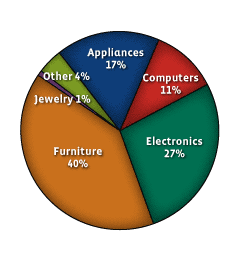

What kind of stuff people rent-to-own

Leasing, licensing, subscribing are all types of shared ownership. (In general we rent for short-term and lease for longer; we'll rent a car for a week, or lease it for 2 years.) There are other variations in the sharing economy, such as rent-to-own, where regular payments go towards the purchase of the good when the purchase price is reached. Low-income families without good credit will often rent-to-own (at predatory lending rates) furniture and appliances they can't afford to purchase. Technically a mortgage is a type of rent-to-own agreement in which ownership transfers to the "renter" at the start of regular payments, but since the mortgagee enjoys the rights of ownership it doesn't follow the patterns of rent.

The latest twist in shared ownership for tangible physical goods is called fractional ownership. It is like time-sharing, but with full ownership privileges and responsibilities. Popular fractional ownership arrangements grant the co-owner a certain number of hours flying in a private jet to the destination of their choice, or driving a super car for 5,000 miles per year, or spending a limited number of days at a resort villa. With fractional ownership you can also share owning a sports team, a racehorse, or a vineyard. A website built to promote fractional ownership of primarily luxury goods puts it this way: "Fractional ownership and asset-sharing gives you an ideal way to get the most out of your investment by purchasing only the shares or time you require from an asset. All other aspects are split, both the benefits and the costs, amongst a limited number of shareholders or members."

The downside to the traditional rental business is the "rival" nature of physical goods. Rival means that there is a zero-sum game; only one rival prevails. If I am renting your boat, no one else can. If I rent a bag to you, I cannot rent the same bag to another. To scale your rental business you have to buy more boats or bags. But of course, intangible goods and services don't work this way. They are "non-rival" which means you can rent the same movie to as many people who want to rent it this hour. Sharing intangibles scales magnificently. This ability to share on a large scale without diminishing the satisfaction of the individual renter is transformative. The total cost of use drops precipitously (shared by millions instead of one). Suddenly, ownership is not so important. Why own, when you get the same utility from renting, leasing, licensing, sharing?

But more importantly why even possess it? Why take charge of it at all if you have instant, constant, durable, full access to it? If you lived inside of the world's largest rental store, why would you own anything? If you can borrow anything you needed without possessing it, you gain the same benefits with fewer disadvantages. If this was a magic rental store, where most of the gear was stored "downstairs" in a virtual basement, then whenever you summoned an item or service it would appear at your command.

The internet is this magic rental store. Its virtual basement is infinite, and it provides omni-access to its holdings. There are fewer and fewer reasons to own, or even possess anything. Via omni-access the most ordinary citizen can get hold of a good or service as fast as possessing it. The quality of the good is equal to what you can own, and in some cases getting hold of it may be faster than finding it on your own in your own "basement."

Access is so superior to ownership, or possession, that it will drive the emerging intangible economy. The chief holdup to full-scale conversion from ownership to omni-access is the issue of modification and control. In traditional property regimes only owners have the right to modify or control the use of the property. The right of modification is not transferred in rental, leasing, or licensing agreements. But they are transferred in open source content and tools, which is part of their great attraction in this new realm. The ability and right to improve, personalize, or appropriate what is shared will be a key ingredient in the advance of omni-access. But as the ability to modify is squeezed from classic ownership models (think of those silly shrink-wrap warranties), ownership is degraded.

The trend is clear: access trumps possession. Access is better than ownership.


Source: Better Than Owning | Kevin Kelly

Tuesday, May 8, 2012

MUST READ! The Final Convergence: Innovation and Nanotechnology: Converging Technologies and the End of Intellectual Property | David Koepsell

The Final Convergence

Intellectual property (IP) was a noble experiment, and it may have been the cause of some of the growth and development we have enjoyed in the last century or two. But its days are now numbered. The end of IP is written into the structure of an ongoing technical and scientific revolution. Nanowares will be the final merger of numerous seemingly disparate technologies into a single, overarching technological infrastructure. This revolution, when fully realized, will alter our fundamental relations among each other, to the products of our creativity, and to the ‘natural’ world. No longer will many of the forces that have driven prices in markets function as they have. Scarcity, in the best version of the nanoware future, will cease. This future is being prepared for by many who are trying to develop it.

I have been trying to make a case, ever since I first examined the nature of cyberspatial goods, that IP regimes do not reflect reality well, and that they can and should be altered (or abolished) to serve our needs, and to better embody both logic and pragmatic ends. The technology is revealing that our preconceptions about the nature of our technical artifacts, as applied through existing IP regimes, are fundamentally flawed. The case is being made for us by both the inadequacy of current legal norms to deal with emerging technologies and the recognition of innovators, who now consciously skirt those regimes, and are instituting and embracing new means to promote and to protect innovation. If we are to pave the way for the full, beneficial, and equitable realization of nanowares, then we must finally declare IP as we know it to be dead, and move on. Let's review what our examination has revealed, and explain why the death of IP means opening a new door for the future of technological and scientific progress and economic prosperity if properly navigated.

Nanowares: What Are They, Really?

I have attempted to use a single word to connect several different paths of current technological approaches to the same goal. The sciences have been pushing technology inevitably toward a convergence, as the fundamental goals of science – better understanding, prediction, and control of nature – have been leading to the development of the technologies that underlie nanowares. The emergence of essentially programmable physical goods will complete the development of two major tracks of technological development. On the one hand, computerization and information and communication technologies (ICT) have involved ever-increasing abilities to manipulate information, and on the other hand, better, more precise, and miniaturized manipulation of the physical world (necessitated in many ways by the underlying technologies of ICT) has involved ever-increasing control over our manufactures or artifacts. The convergence of information technologies and manufacturing means fundamentally rethinking our connection to our artifacts, as discussed in the chapters above.

One exciting feature of these converging technologies is how they are finally converging. I have specifically included in the analysis of nanowares technologies that are clearly not nanotechnology. There are two reasons for including in discussions about nanotech and innovation the grassroots development of localized or microfabrication technologies. The first is that those who are behind the emergence of these technologies have their theoretical roots in nanotech. The second is that the tools and infrastructures that they are developing capture many of the same issues as those that will be presented by the full realization of molecular nanotechnology (MNT). The goals of enabling the complete accessibility of all potential means of production, and of liberating fully human creativity from the traditional demands of capital, are implicit in the Fab Lab, RepRap (and other) micro-manufacturing efforts, and will be the ultimate inevitable result of true MNT. Because I (and others) see both streams of development as meeting at some future point, and motivated by the same ultimate goals, a single term ‘nanowares’ has been used throughout this argument.

We should treat all of these emerging and converging technologies as a kind, and look for ways we can precipitate their smooth arrival and realize their full potential. Ultimately, I do not think there is any real danger that governments or others who foolishly seek to keep alive current IP paradigms, and extend them to nanowares, can succeed. In fact, it is encouraging that while some of us try to justify the theoretical underpinnings of a movement, the movement itself marches inexorably onward, propelled by the general acceptance of its tenets. IP has been breaking down for some time as a result of half of the two-track movement toward true MNT. Even as the patent profession (really, the patent industry, in which patent lawyers, courts, and other related professionals are assured of profits by the mere filing and litigation of patents) seeks to bolster their floundering field against the tide of radical change brought about by ICT, those who are innovating in software have learned how to work around the legal impediments to innovation, and work out among themselves a more just spectrum of rights and expectations. This is happening as well in nanowares. It is part of the nature of the technology that openness and free markets will drive innovation in the field, and it moves those working in it at least away from excessive upstream patenting, and at most, toward open source paradigms.

In both the grassroots nanowares approaches to microfabrication (including desktop fabrication) and in the realm of synthetic biology, where bio-bricks approaches ensure free and open access to the foundational research and components, researchers and innovators alike are taking matters into their own hands and preventing patents from impeding these emerging sciences. The same trend motivated both industry and individuals to disclose rather than enclose genes in the race to decode the human genome and thereafter. Nanowares are thus part of a spectrum, and the continuation of a trend. The patent industry will grow louder, and look to governments to secure their domains, even as those who are doing much of the work in both the science and innovation work steadily to keep this expanding domain open.

In many ways, this book is not a call for action, but rather an attempt to theoretically explain trends that will occur anyway. It is descriptive rather than normative. Nanowares will be open, eventually, and IP will continue to break down, with or without philosophers making the case that it should. But some remain unconvinced, and innovators and scientists are still at the mercy of states, as well as market forces, that sometimes work at cross-purposes, and that are often impelled by habit rather than reason to continue to support dying methods and ideologies. Even while I am certain that the seeds of revolutionary change in our thinking about the natures of artifacts are embedded in the technology itself, we should be mindful of the pernicious ability of those whose domains are threatened, even by the inevitable, to attempt to secure their monopolies.

I have argued throughout my informal IP trilogy that where institutions or norms conflict with grounded principles of justice, we must seek justice. This is an ethical argument, and suggests that the forces I describe, and which are moving technology and science, are good, and that attempts to impede that development are the opposite. You may well accept the trends I have described, their economic efficiency, their inevitability, and their benefits for innovation without accepting the ontological and ethical arguments that pervade this text, but I have tried to point out the shortcomings of mere utility as a foundation for action. Let's look briefly at why ethics and justice ought to finally motivate us to embrace nanoware without IP, and why ethical foundations ought to be part of our thinking in science and technology in general. There are sound historical reasons to believe that some things are better than others, not just instrumentally, but also fundamentally.

Ethics and Innovation

If science and technology never had any impact on rights or duties, and if IP law did not impede some of those rights and duties, then philosophers could avoid confronting the ethical issues raised by new technologies like nanowares. But each new technology presents us with a range of new considerations regarding the rights of scientists, innovators, and the public, and the proper role of states in ensuring justice. It is a modern trend to incorporate earlier in the development of new technologies ethical considerations that are anticipated to pose impediments or lead to harms. As discussed above, most of the discussion regarding nanowares has focused upon potential harms posed in the realm of safety, security, public risks, and environmental impacts. All of this inquiry is warranted, given the experiences of harmful technologies in the past, and we have delved into them briefly above. But the argument I have been making in this text focuses primarily on IP, and how the current IP regime threatens the development of the technology itself. While I am mindful of, and concerned about, potential physical harms arising from nanowares, and indeed support inquiry into the general ethical duties of researchers and innovators in avoiding those sorts of harms, I am most concerned with the implications for justice arising from the application of current IP norms to this and other technologies.

We are not, as individuals, entitled to the fruits of innovation. I do not think there is a duty, either, for anyone to innovate. Nor do I think that justice requires the free dissemination of physical goods that result from innovation to either the needy or the wealthy. But I do think that states ought not to impede either individual human creativity or markets for the fruits of that creativity. There may well be individual, moral duties to contribute to society, and to not harm others consistent with Mill's oft-spoken about (and incorporated herein) ‘harm principle.’ I would certainly encourage innovators to innovate, to share the fruits of their innovation openly, and to enable others to improve upon their own innovations. Doing so would certainly be what ethicists consider to be supererogatory goods, or praiseworthy (morally speaking). But this is not an argument for achieving some moral utopia through adopting socialist principles such as the famous maxim: ‘to each according to their needs, from each according to their ability.’ Instead, it is a call to let markets sort out prices, free from state interference, and to allow human creativity to thrive without creating artificial barriers in the form of state-sanctioned monopolies.

I do not mean to imply that an utterly free market in innovation will result universally in ‘the good,’ ethically speaking. Rather, it is clear from history that people will do bad things, intentionally or unintentionally, and that states have sometimes tried to step in to rectify harms in some cases, and succeeded sometimes. The law and the state have played roles in marshaling public resources to great good in the past, and have in fact helped us to achieve our current level of innovation and wealth through various means, including through the allocation of resources to both science and industry. It is not per se unethical that we should make such democratic choices about allocation, control, regulation, or preference where those choices are truly democratic, and where harms might be avoided with certainty. Neither is it per se necessary that states do any of these. Looking at past examples, as we have a bit throughout the above argument, there are clear instances of state failures, in both allowing for and in some cases precipitating harms. Moreover, there is an even clearer history of state error in its actions regarding markets. There is as yet no good evidence that attempts to influence markets, especially in the development and dissemination of new technologies, are necessarily successful. Such attempts are also arguably bad, in a moral sense, when they involve impediments of natural rights (to life, liberty, or property, for instance). I believe that nanotechnology presents us with an important choice, and that many who are involved in this nascent field have already made that choice. The choice is: Do we wish to adopt failed IP policies in nanowares, or pursue new paths to liberate both the science and its development through technology?

We have other choices to make as well. For instance, should we pursue informal policies, or create institutions that help us to track dangerous materials, precursors, or final products that enter the stream of commerce? Are there some sorts of technologies that need to incorporate limitations, for instance on the potential negative consequences of unhindered self-replication? Should scientists and innovators choose to abide by certain ethical principles in general? All of these choices have ethical implications. The common thread of everything I have tried to demonstrate, and the overarching thesis of this book, is that it is the nature of each of the above as choices that is most important.

Continue reading (Long Read) - The Final Convergence: Innovation and Nanotechnology: Converging Technologies and the End of Intellectual Property