If I have seen further it is by standing on the shoulders of giants.

Thursday, December 23, 2010

ITALY REVOLT - Students battle with riot police in Palermo as Italy sees new wave of protests


ROME — Thousands of students took to the streets across Italy on Wednesday amid heavy security to protest against a radical reform of the university system planned by Prime Minister Silvio Berlusconi's government.

Riot police fired tear gas in Palermo and clashed with students, protesters occupied train tracks in Naples and several hundred students briefly occupied the Mole Antonelliana -- the main landmark in the northern city of Turin.

But the protests were largely peaceful -- in contrast to an anti-government rally in Rome last week that degenerated into a riot in the city centre in which cars were set alight and a total of nearly 200 people were injured.

Wednesday's protests were taking place as the Senate, the upper house of parliament, prepared to vote its final approval on the university reform.

La Repubblica daily said around 30,000 students took part in the protest in Rome alone, Corriere della Sera estimated their number at 10,000.

Student activists have urged President Giorgio Napolitano, who met with a small group of protesters on Wednesday, not to sign the reform into law.

Protest organisers in Rome had said that they would avoid a confrontation with police by steering clear of the "palaces of power" in the city centre.

"I hope that everything takes place without any serious incidents," Education Minister Mariastella Gelmini told reporters.

Several hundred students clashed with police in Palermo in Sicily as they tried to enter a local government building. A group of students was later seen throwing stones and bottles at the main police station in the city.

The university reform -- which would merge some smaller universities, limit the hiring of lecturers and introduce non-academic university deans -- is set to be adopted definitively by the Senate later this week.

The student protest -- seen by critics as an effort to cut budgets for state universities -- has become part of a wider opposition movement against the government's austerity measures and high rates of youth unemployment.

Continue reading - Thousands of Italian students take to the streets

Student protesters in Italy clashed with police in the Sicilian capital Palermo on Wednesday as part of nation-wide demonstrations over university budget cuts that are expected to be approved by parliament. Carrying placards bearing the name of famous books, thousands of protesters marched through the streets, some wearing helmets similar to those used by riot police. One of Rome's most famous fountains on Gianicolo Hill ran red after demonstrators poured red paint into the water. Students said the red colour symbolised both the blood spilt in last week's violent protests, and the budgets of Italy's education system. Its reported that protests in Rome, Milan and Sardegna had so far passed off peacefully.

Students battle with riot police in Palermo as Italy sees new wave of protests

Freedom Watch - Special Edition: "Den of Vipers" Highlights

Dec. 21, 2010 -Judge Andrew Napolitano's hit show, Freedom Watch, kicked off the winter season with a bang as it played host to an all-star cast, taking on the Federal Reserve at full-throttle!

Congressman Ron Paul partakes in an in-depth discussion regarding the Federal Reserve, its effectiveness, and its shifting position in the mainstream political dialogue.


Historian and Best-Selling Author, Tom Woods, attacks Ben Bernanke's policies, the history of central banking in America, political partisan interests, and the future of the Fed.


Financial guru, Jim Rogers, discusses sound investments, central banking, and basic economic principles in a healthy financial portfolio.


GMU economics professor, Russ Roberts, and filmmaker (and Campaign for Liberty member), John Papola, elaborate on the creation of their viral video sensation, the Hayek vs Keynes dichotomy, and the role of savings on the road to prosperity.


The Judge wraps up the episode and lays down the plain truth of the Federal Reserve while exposing the "den of vipers" that has relentlessly sought to entangle and poison the financial system throughout American history.

Wednesday, December 22, 2010

Ron Paul on C-SPAN's Newsmakers

When the 112th Congress convenes next month, Rep. Ron Paul (R-TX) will become the chairman of the Financial Services Subcommittee on Domestic Monetary Policy and will have Congressional oversight of the Federal Reserve.

On C‑SPAN's Newsmakers, he shares his concerns regarding the agency's monetary policies. In the past, the representative has been very vocal in his criticism of the way the Fed is handled and has gone so far as to propose that it be eliminated in his latest book, "End the Fed."

Rep. Paul also explain his agenda concerning financial issues and how they harmonize with the incoming Republican-majority's overall agenda, as well as efforts to stimulate the sagging U.S. economy.

Ron Paul on C-SPAN's Newsmakers

Thursday, December 16, 2010

Europe On Fire

Riots in whole of EU and Russia! Is year 2010 when the Revolution starts?

Riots in EU 2010

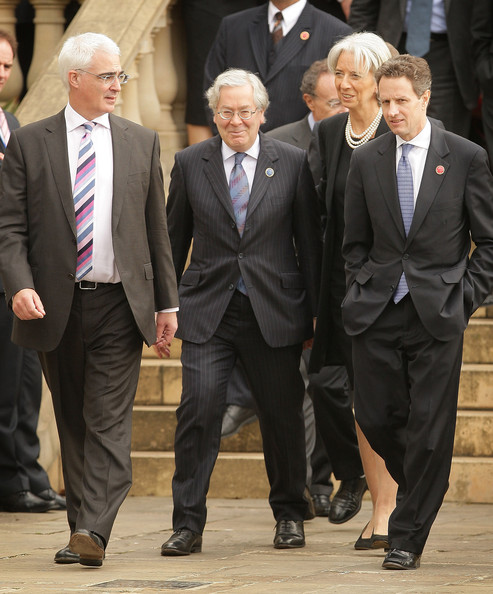
WikiLeaks: Mervyn King says in March 2008 bailout fund needed


Monday, 17 March 2008, 18:27
C O N F I D E N T I A L LONDON 000797
SIPDIS
NOFORN
SIPDIS
EO 12958 DECL: 03/17/2018
TAGS ECON, EFIN, UK
SUBJECT: BANKING CRISIS NOW ONE OF SOLVENCY NOT LIQUIDITY
SAYS BANK OF ENGLAND GOVERNOR

Classified By: AMB RTUTTLE, reasons 1.4 (b) and (d)

1. Since last summer, the nature of the crisis in financial markets has changed. The problem is now not liquidity in the system but rather a question of systemic solvency, Bank of England (BOE) Governor Mervyn King said at a lunch meeting with Treasury Deputy Secretary Robert Kimmitt and Ambassador Tuttle. King said there are two imperatives. First to find ways for banks to avoid the stigma of selling unwanted paper at distressed prices or going to a central bank for assistance. Second to ensure there's a coordinated effort to possibly recapitalize the global banking system. For the first imperative, King suggested developing a pooling and auction process to unblock the large volume of financial investments for which there is currently no market. For the second imperative, King suggested that the U.S., UK, Switzerland, and perhaps Japan might form a temporary new group to jointly develop an effort to bring together sources of capital to recapitalize all major banks.

Systemic Insolvency Is Now The Problem

END SUMMARY

2. King said that liquidity is necessary but not sufficient in the current market crisis because the global banking system is undercapitalized due to being over leveraged. He said it is hard to look at the big four UK banks (Royal Bank of Scotland, Barclays, HSBC, and Lloyds TSB) and not think they need more capital. A coordinated effort among central banks and finance ministers may be needed to develop a plan to recapitalize the banking system.

Unblocking Illiquid Mortgage-Backed Securities

3. King said it is also imperative to find a way for banks to sell off unwanted illiquid securities, including mortgage backed securities, without resorting to sales at distressed valuations. He said sales at distressed values only serve to lower the floor to which banks must mark down their assets (mark to market), thereby forcing unwarranted additional write downs. He said we need to find an auction system where banks could move paper they want to sell without fear of stigma that the market views selling at a low price as a sign that a bank is in trouble. King said, however, he did not yet know how to structure such an auction and that further dialogue was needed. Kimmitt acknowledged the need to find ways to unblock these markets and said we should remain in touch bilaterally as well as in the G-7, the Financial Stability Forum, and the central banks.

A Possible Approach To Recapitalization

4. The G-7 is almost dysfunctional on an economic level, said King. Key economies are not included, especially those that have large and growing pools of capital. King said that a new international group was needed to address the issue. It could be a temporary group, and he suggested that perhaps the central banks and finance ministers of the U.S., the UK, and Switzerland could coordinate discussions with other countries that have large pools of capital, including sovereign wealth funds, about recycling dollars to recapitalize banks. King said Japan might not be included because it has little to offer. King noted, though that including the Japanese might force their hand in finally marking to market impaired assets. Kimmitt said that he was cautious about starting new groups in the international financial community because of the inevitable debate around whom to include.

5. The King proposals were not casual ideas developed in the course of luncheon conversation. It was clear that his principal objective in the meeting was to outline his outside-the-box thinking for Kimmitt. King included very few details about his proposals and was content to present broad concepts, thereby planting the seeds for future discussion. END COMMENT.

6. Participants: USG: Ambassador Robert Tuttle; Deputy Secretary Kimmitt; Eric Meyer, Office Director for Europe;

SIPDIS Robert Saliterman, Spokesman, International Affairs, U.S. Treasury; Warren Chane, ECONOFF. UK: Mervyn King, Governor, Bank of England; Chris Salmon, Private Secretary.

7. Deputy Secretary Kimmitt has cleared this message.

Source - US embassy cables - Mervyn King says in March 2008 bailout fund needed

Bloomberg - WikiLeaks: BoE suggested global bank bailout in 08

CNBC - BoE Sought Global Bank Bailout in 2008

DailyMail - Bank of England boss Mervyn King, not Gordon Brown, 'was bank bailout mastermind'

BREAKING: Clashes as Greece gripped by fresh strike


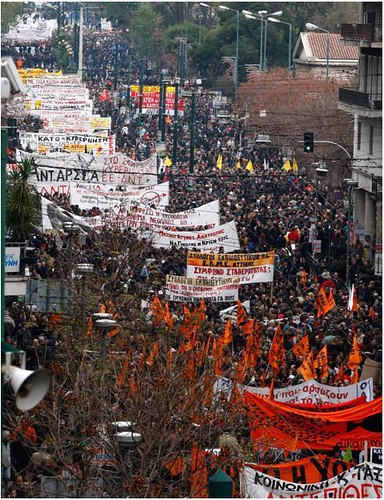
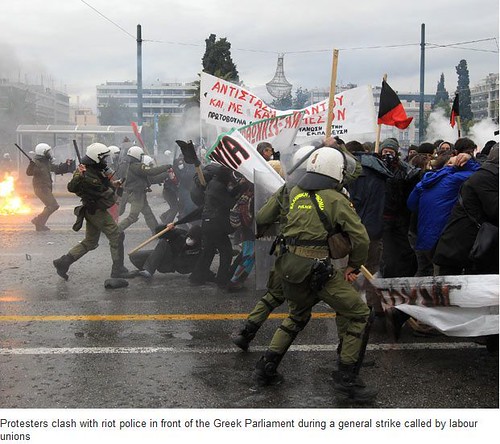
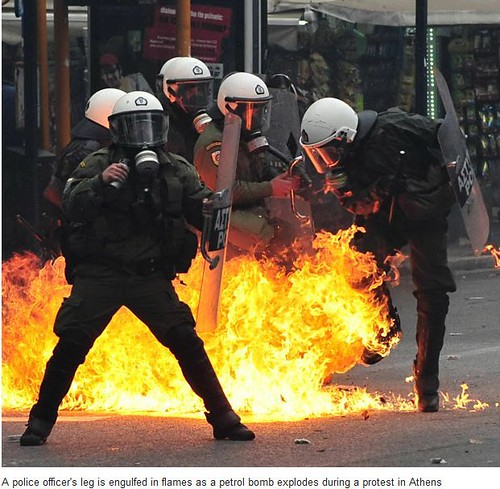
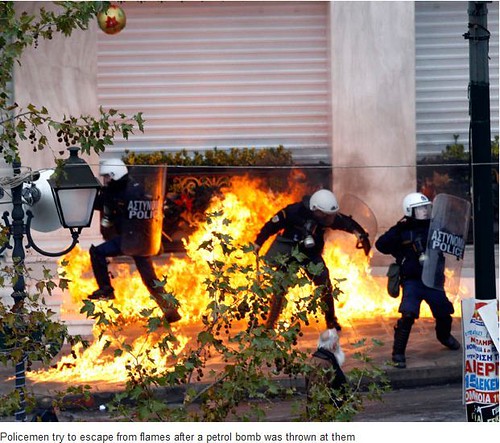
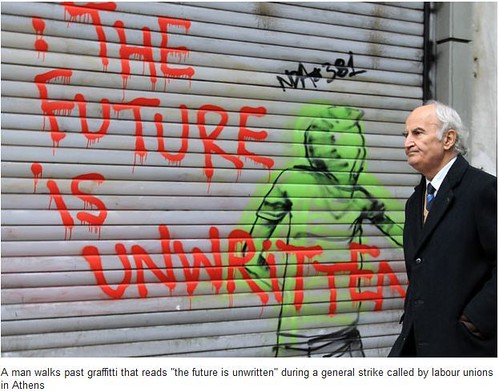
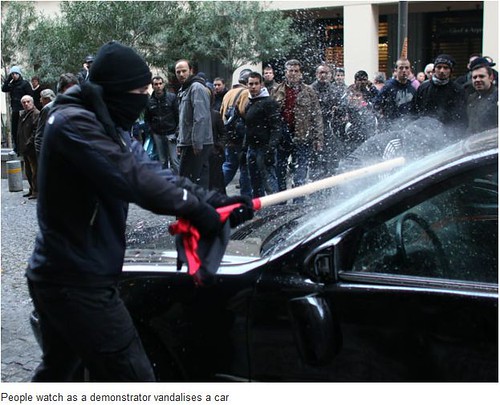
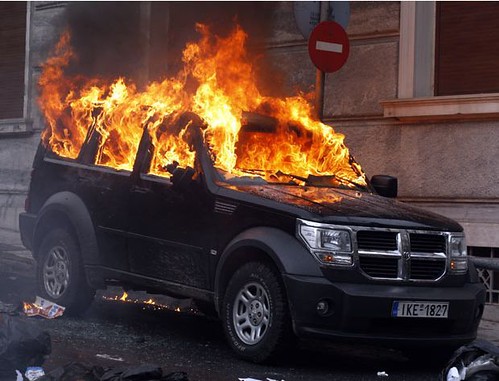
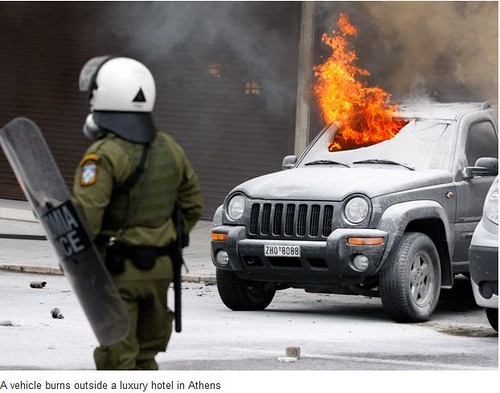
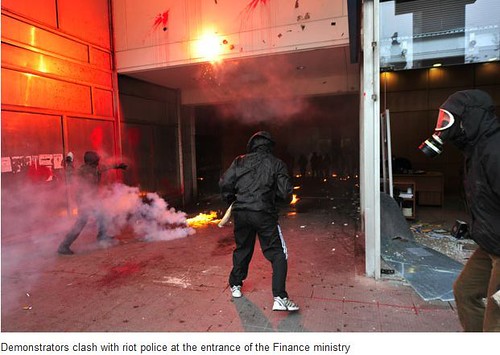
Greek police have clashed with protesters in the capital Athens as unions stage a general strike against government austerity measures.

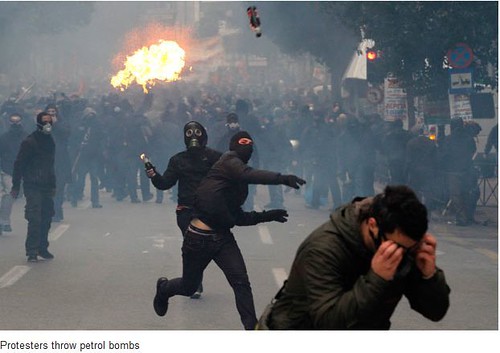
Demonstrators threw petrol bombs and police responded with tear gas as the violence flared outside parliament.

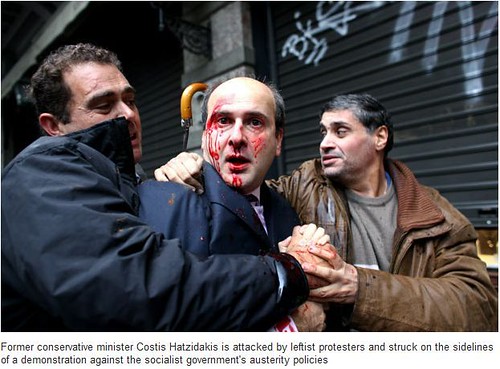
A former minister was chased and beaten by a mob and forced to seek shelter in a building.

The day of action has grounded flights, disrupted public transport and closed schools across the country.

It is the seventh general strike this year following tough reforms needed to receive a 110bn euro (£84bn) bail-out from international organisations.

Police said about 15,000 people were taking part in marches in Athens.

Protesters started fires around luxury hotels in Syntagma Square, outside parliament. Riot police fired several rounds of tear gas in response.

The BBC's Malcolm Brabant in Athens says the scenes are some of the ugliest in a year of protests marking the country's economic crisis.

He says a lynch mob atmosphere developed as former conservative minister Kostis Hatzidakis emerged from parliament and was chased by dozens of protesters.

The opposition MP was pictured surrounded by a mob and with blood pouring from a head wound. Mr Hatzidakis's office said he was unable to reach hospital because of the crowds.

Witnesses said demonstrators shouted at him: "Thieves! Shame on you!"

Continue reading - BBC - Clashes as Greece gripped by fresh strike

Live Feed from General Strike in Greece December 15th-Unrest in the Streets


FULL GALLERY HERE - Petrol Bomb Riots In Greece

Action video of Greece riots as fire bombs, stones fly in Athens


2nd General strike in a week,Greek police dodge molotov cocktails... will America be next?


VIOLENT POLICE RIOTS IN ATHENS 15-12-2010

Europe faces rising austerity protests in 2011

As austerity bites, Western Europe faces a near inevitable rise in protest and unrest in 2011 which is likely to hit markets and dampen weak governments' appetite for reform but not affect policies dramatically.

So far, social unrest over the financial crisis has varied from country to country. In some of the worst affected nations such as Ireland and Latvia, acceptance and even apathy has prevailed, while Greece has seen fatalities and street clashes.

Increasingly, there are signs of rising social pressures. Many Western European countries are only just embarking on multi-year deficit-reduction packages, a hard sell in states where expectations have risen for generations.

Greek protesters clashed with police in central Athens on Wednesday as tens of thousands marched against austerity measures aimed at pulling the country out of a debt crisis. On Tuesday, Italian rioters and police fought battles in Rome after Prime Minister Silvio Berlusconi won a no-confidence vote.

Britain saw its worst clashes in two decades last week as students demonstrated over tuition fee rises, with Prince Charles and wife Camilla caught up in the melee. More unrest is expected next year as unions protest against much broader cuts.

"It's almost inevitable that there will be more protest in 2011 than 2010, particularly in countries such as Greece and the UK where there are real public divisions over how much austerity is necessary," said Carina O'Reilly, European security analyst at IHS Jane's. "It's going to get nastier. We could well see deaths or serious injuries. We could well have seen deaths in the London riots last week. We were just lucky."

None of the European protests have so far had a major policy impact. But in some countries at least, particularly those with upcoming elections, worries over further unrest will deter the government from more aggressive reforms.

Continue reading - Reuters - Europe faces rising austerity protests in 2011

Wednesday, December 15, 2010

Will the Fed be able to survive Ron Paul?


The erstwhile presidential candidate and soon to be head of Congressional oversight of the Federal Reserve talks gold, jobs and the presidency with Fortune.

If there's anything to be said about U.S. Congressman Ron Paul, he sure is persistent. And lately, that inner flame that's helped him gain the reputation for sometimes being the "G.O.P. loner" appears to be paying off.

The soft-spoken obstetrician has represented the 14th District of Texas on and off since 1977, spending much of his political career arguing that the Federal Reserve is evil for America and far too secretive. He doesn't see why there's so much faith in paper money, including the U.S. dollar. If Paul had it his way, there'd be a return to the gold standard. He even laid out his case in his book, End the Fed.

Lately though Paul's views are garnering the attention that he and supporters have long been waiting for. Earlier this month, Paul was picked to head the House subcommittee on domestic monetary policy. That means he will help oversee the body he's opposed to -- the Federal Reserve -- as well as currency and the dollar's value.

If anything, it appears the timing somehow worked out for beliefs that Paul has held for decades. The congressman's backing has grown considerably with the rise of the Tea Party, whose frustrations with government bailouts of big banks and corporations following the financial crisis seem to fall in line with Paul's views.

What are the Federal Reserve's shortcomings?

They're doing a job that's impossible to do. So it's not a single person's fault. It's not just former Chairman Alan Greenspan or just current Chairman Ben Bernanke. It's the assumption that anybody knows what interest rates should be, or the assumption that they know what money supply should be, or the assumption that they can have stable prices or the assumption that they could deal with unemployment.

Do you think we're better off without a Central Bank?


Sure, it's better off that we don't have depressions and inflations and financial chaos and the problems that we face. We of course wouldn't have this backdoor financing of big government fighting wars overseas and getting people to depend on the welfare state. None of that can happen without a Federal Reserve.

So what do you think the economy would look like without the Fed?

We'd probably have a much healthier economy – it wouldn't be so fragile. Nobody would be worrying about currency exchange rates and people wouldn't be in and out of currencies and spending all their energy doing what they're doing. Also, we wouldn't have a situation where the Fed creates money and hands it out for free and let's the banks make billions of dollars. And the poor people who are retired and have CDs get nothing and because of the downturn in the cycle, which the Fed creates, people lose their jobs and lose their houses. You wouldn't have any of that.

This was all very clearly predicted by Austrian economic theory and it's come about and it's very disturbing to the Fed because they're going to have to recognize that their theories are completely wrong and they're not about to do that gracefully.

Continue reading - Fortune - Will the Fed be able to survive Ron Paul?

The Rise of Ron Paul

Once shunned by the mainstream media, made fun of by establishment politicians, and questioned by political pundits, Congressman Ron Paul is finally getting the fifteen minutes of mainstream media fame that his followers say are so well deserved. In a recent NY Times profile, the Republican Congressman was quoted as saying that there is a "50-50 chance" that he will run again. His views on everything from domestic policy, to monetary reform, to US policy abroad are alternative, to say the least, but they seem to be catching on. His message is resonating even more with the rise of the tea party movement, and subsequently, the rise of Ron Paul himself.

The Rise of Ron Paul

Monday, December 13, 2010

Ron Paul, G.O.P. Loner, Comes In From Cold


Ron Paul in November 2007 campaigning for president. He is considering another run in 2012.

WASHINGTON — As virtually all of Washington was declaring WikiLeaks’s disclosures of secret diplomatic cables an act of treason, Representative Ron Paul was applauding the organization for exposing the United States’ “delusional foreign policy.”

During his 20 years in Congress, Mr. Paul has staked out the lonely end of 434-to-1 votes against legislation that he considers unconstitutional, even on issues as ceremonial as granting Mother Teresa a Congressional Gold Medal. His colleagues have dubbed him “Dr. No,” but his wife will insist that they have the spelling wrong: he is really Dr. Know.

Now it appears others are beginning to credit him with some wisdom — or at least acknowledging his passionate following.

After years of blocking him from a leadership position, Mr. Paul’s fellow Republicans have named him chairman of the House subcommittee on domestic monetary policy, which oversees the Federal Reserve as well as the currency and the valuation of the dollar.

Mr. Paul has strong views on those issues. He has written a book called “End the Fed”; he embraces Austrian economic thought, which holds that the government has no role in regulating the economy; and he advocates a return to the gold standard.

Many of the new Republicans in the next Congress campaigned on precisely the issues that Mr. Paul has been talking about for 40 years: forbidding Congress from any action not explicitly authorized in the Constitution, eliminating entire federal departments as unconstitutional and checking the power of the Fed.

If there is vindication here, Mr. Paul says, it is for Austrian economic theory — an anti-Keynesian model that many mainstream economists consider radical and dismiss as magical thinking.

The theory argues that markets operate properly only when they are unfettered by government regulation and intervention. It holds that the government should not have a central bank or dictate economic or monetary policy. Once the government begins any economic planning, such thinking goes, it ends up making all the economic decisions for its citizens, essentially enslaving them.

The walls of Mr. Paul’s Congressional office are devoid of the usual pictures with presidents and other dignitaries. Instead, there are portraits of Ludwig von Mises and Murray Rothbard, titans of the Austrian school. For years, Mr. Paul would talk about their ideas and eyes would glaze over. But during his presidential campaign, he said he began to notice a glimmer of recognition among those who attended his events, particularly on college campuses.

Continue reading - NY Times - Ron Paul, G.O.P. Loner, Comes In From Cold

Sunday, December 12, 2010

The Fed? Ron Paul’s Not a Fan


Ben S. Bernanke, the chairman of the Federal Reserve, has been attacked for failing to foresee the financial crisis, for bailing out Wall Street, and, most recently, for injecting an additional $600 billion into the banking system to give the slow recovery a boost.

But Mr. Bernanke will face even more scrutiny in the months to come. On Thursday, House Republican leaders announced that Representative Ron Paul of Texas, the outspoken Republican libertarian who ran for president in 2008, will become the chairman of the subcommittee that oversees the Fed. His position on the central bank is captured in the title of his 2009 book, “End the Fed” (Grand Central Publishing).

Here’s some of what he wrote:

The Beginning of the End

“The day the Fed came into being in 1913 may have been the beginning of the end, but the powers it obtained and the mischief it caused took a long time to become a serious issue and a concern for average Americans.”

The Gold Standard

“Whenever I talk of a gold standard, there are always people ready to accuse me of having some obsession or fixation. Fetish is a word thrown around. In fact, I’m only observing reality: the idea of sound money in most of human history has been bound up with gold money.”

A Full-Time Counterfeiting Operation

On Mr. Bernanke: “There is something fishy about the head of the world’s most powerful government bureaucracy, one that is involved in a full-time counterfeiting operation to sustain monopolistic financial cartels, and the world’s most powerful central planner, who sets the price of money worldwide, proclaiming the glories of capitalism.”

New Money Out of Thin Air

“Only the Federal Reserve can inflate the currency, creating new money and credit out of thin air, in secrecy, without oversight or supervision. Inflation facilitates deficits, needless wars and excessive welfare spending.”

Fed Chairmen He Has Known

“Being in Congress in the late 1970s and early 1908s and serving on the House Banking Committee, I met and got to question several Federal Reserve chairmen: Arthur Burns, G. William Miller and Paul Volcker. Of the three, I had the most interaction with Volcker. He was more personable and smarter than the others, including the more recent board chairmen Alan Greenspan and Ben Bernanke.”

Low Interest Rates

“Artificially low interest rates are achieved by inflating the money supply, and they penalize the thrifty and cheat those who save. They promote consumption and borrowing over savings and investing. Manipulating interest rates is an immoral act. It’s economically destructive.”

The Bailouts

“Today, there is no principled opposition to the corporate bailouts and the Fed’s trillions of dollars of new credit and the takeover of insurance, mortgages, medical care, banks and the auto industry. The arguments have only been over amounts, financial vehicles, and which political group gets to wield the economic power. If there is no moral argument against the economic takeover of America, there will be no resistance to the dictator who rules over our lives with an iron fist.”

The Obama Legacy

“For the same reason a disease cannot be cured by more of the germ that caused it, the inflation and debt accumulation of the Obama years will not inflate our way out of it. This depression will likely last and last.”

Continue reading - NY Times - The Fed? Ron Paul’s Not a Fan

Saturday, December 11, 2010

Fed Overseer Ron Paul Says He Doubts Bernanke Can Prevent Inflation Surge


Representative Ron Paul, a Texas Republican who next month will take control of the House subcommittee that oversees the Federal Reserve, said he’s concerned the central bank won’t be able to prevent an outbreak of inflation.

Fed Chairman Ben S. Bernanke said during an interview broadcast Dec. 5 on CBS Corp.’s “60 Minutes” he was “100 percent” confident the Fed could keep inflation below 2 percent and reverse its accommodative monetary policy when necessary. Policy makers “could raise interest rates in 15 minutes,” if needed, he said.

This optimism of Bernanke who says that when the prices start to go up, he can turn that off in 15 minutes, I don’t think he fully understands the subjective theory of value and how prices have a psychological reason for going up, too,” Paul said today on Bloomberg Radio’s “The Hays Advantage” with Kathleen Hays. “When people lose confidence, prices go up, and you can’t turn that psychology off in a minute

Continue reading - Bloomberg - Fed Overseer Ron Paul Says He Doubts Bernanke Can Prevent Inflation Surge

Dr. Ron Paul on Fox & Bloomberg 12/10/10

Congressman Ron Paul interviewed on Friday concerning his subcommittee and the Fed's actions during the economic crisis.

Ron Paul on Fox Business December 10 2010


Ron Paul on Bloomberg December 10 2010

Friday, December 10, 2010

Ron Paul, Author of `End the Fed,' to Lead Panel Overseeing Central Bank


Representative Ron Paul, Texas Republican and author of “End the Fed,” will take control of the House subcommittee that oversees the Federal Reserve.

“This is the leadership team that crafted the first comprehensive financial reform bill to put an end to the bailouts, wind down the taxpayer funding of Fannie Mae and Freddie Mac, and enforce a strong audit of the Federal Reserve,” Bachus said in a statement.

Paul, in an interview last week, said he plans a slate of hearings on U.S. monetary policy and will restart his push for a full audit of the Fed’s functions.

“We are ready to hit the ground running, and I look forward to continuing our work in the next Congress,” Bachus said.

Paul, who has introduced legislation to abolish the Fed, became nationally known during his 2008 presidential campaign. His campaign to audit the Fed picked up steam as the central bank deployed trillions of dollars in emergency loans in the midst of the worst financial crisis since the Great Depression. Paul’s bill gained the support of 320 of 435 members of the House and a portion of the measure ended up in the Dodd-Frank financial regulatory overhaul enacted this year.

“Congress must act to rein in Chairman Bernanke and the Fed before they destroy our currency and permanently damage our economy and financial system,” Senator Jim Bunning, a Kentucky Republican, said in his farewell speech on the Senate floor today. “Public awareness of what the Fed is doing is increasing while public opinion of the Fed is falling.”

Bunning’s views are reflected throughout the country, according to a Bloomberg National Poll that reveals deep skepticism about the Fed.

Continue reading - Bloomberg - Ron Paul, Author of `End the Fed,' to Lead Panel Overseeing Central Bank

More Than Half of Americans Want Fed Reined In or Abolished


A majority of Americans are dissatisfied with the nation’s independent central bank, saying the U.S. Federal Reserve should either be brought under tighter political control or abolished outright, a poll shows.

The Bloomberg National Poll underlines the extent to which the central bank’s standing has suffered as it has come under fire in Congress, first from Democrats for regulatory lapses before the financial crisis and then from Republicans for failing to revive an economy in which the jobless rate hovers near 10 percent. Voters from both parties have criticized the Fed’s $3.3 trillion in aid to the financial system.

Americans across the political spectrum say the Fed shouldn’t retain its current structure of independence. Asked if the central bank should be more accountable to Congress, left independent or abolished entirely, 39 percent said it should be held more accountable and 16 percent that it should be abolished. Only 37 percent favor the status quo.

In a previous poll, conducted Oct. 7-10, 35 percent of Americans said the Fed should be radically overhauled, while 8 percent said it should be abolished.

Republicans and independents are more likely to support ending the Fed, with 19 percent of independents, 16 percent of Republicans, and 12 percent of Democrats wanting to do away with the central bank. Among those who identify themselves as supporters of the Tea Party movement, which wants to rein in government, 21 percent want to abolish the Fed.

Continue reading - Bloomberg Poll - More Than Half of Americans Want Fed Reined In or Abolished