If I have seen further it is by standing on the shoulders of giants.

Sunday, January 30, 2011

LONDON PROTEST - Students join unions to protest against cuts


Thousands of protesters took to the streets across Britain on Saturday in a new wave of protests against government plans to hike university tuition fees and scrap education grants.

The protests in London and Manchester are the first major demonstrations since late last year when students laid siege to London's government district and attacked a limousine carrying heir-to-the-throne Prince Charles and his wife.

Saturday's protests were largely peaceful.

Holding banners marked "What Parliament does, the streets can undo" about 3,000 noisy but good-humoured protesters marched through central London to Westminster.

Ciara Squires, 18, from Portsmouth, at Queen Mary (London University) said she was marching for her 16-year-old sister:

"Education should be free. My little sister is going to lose her EMA (grant) and drop out of college, and then she might not be able to go to university," Squires said.

"Parliament is not listening to us and most of the people in college can't vote, so we should be out here (marching), that's the only way we can express our opinions," she added.

Chanting "London - Cairo, unite and fight" the march then moved on to the Egyptian embassy, where a demonstration calling for Egypt's President Hosni Mubarak to step down was being held.

In the northern English city of Manchester some of Britain's biggest trade unions joined forces with students as anger about the Conservative-led coalition government's austerity cuts boiled over into wider sectors of society.

Media reports said six people had been arrested following a minor scuffle.

Sally Hunt, general secretary of the University and College Union (UCU), told protestors that the Conservative-led coalition's cuts unfairly targeted young people.

"From sacking lollipop ladies and closing youth clubs, to axing college grants and trebling tuition fees, this is a government at war with our young people and therefore at war with our future," Hunt said.

The coalition government plans to cut 2.9 billion pounds ($4.64 billion) of state support a year for universities to help tackle a budget deficit now at about 11 percent of national output following the global financial crisis.

The government says the higher student fees will be fairer than the present system, and that it will give poorer students more financial support.

Continue reading - Reuters - Students join unions to protest against cuts

London Student Protests, Saturday 29/01/2011


Student protest in Manchester


Student protest, oxford street London


Students Take To Streets For Cuts Protest In London & Manchester - 29th January 2011

Saturday, January 29, 2011

EGYPT REVOLT UPDATE - Egyptian Hopes Converge in Fight for Cairo Bridge


CAIRO — The battle had gone on for hours, and the end of the bridge was in sight. Somewhere past the green armored cars and through the smoke was Liberation Square. For miles the protesters had marched peacefully, shouting at balconies for their neighbors to join them.

But water cannons and tear gas halted the march, for a time. Atef Badr, 28, turned to the retreating protesters with tears stirred by the moment, not the gas. “I’m begging you,” he screamed. “All of you in the back, come forward!”

A few tear gas canisters got caught in the wind and drifted away toward the river: an opportunity. The protesters surged forward, chanting, “Overthrow Mubarak!” They gained ground and then lost it, when the dull metal gas canisters started falling again.

So it went all afternoon on the Kasr al-Nil Bridge, as thousands of protesters tried again and again to get past the riot police, who were just as determined to keep them at bay: first with gas and water cannons, and then by beating them with truncheons.

The long struggle for the bridge set the tone for the momentous events throughout the country on Friday. Egyptians slowly shed their fear of President Hosni Mubarak’s police state and confronted its power, a few halting steps at a time.

The protesters came from every social class and included even wealthy Egyptians, who are often dismissed as apolitical, or too comfortable to mobilize. For some of them in the crowd on Friday, the brutality of the security forces was a revelation. “Dogs!” they yelled at the riot police, as they saw bloodied protesters dragged away. “These people are Egyptians!”

Continue reading - NY Times - Egyptian Hopes Converge in Fight for Cairo Bridge

28th Jan. 2011 - Storyful - Egypt Cairo uprising protest video - Mohamed Ibrahim Elmasry

MALAYSIA - Rise in statutory reserve requirement expected

Industry observers believe that a hike in the statutory reserve requirement (SRR) by Bank Negara is likely at the next monetary policy committee (MPC) meeting in March.

The SRR is a monetary policy instrument available to Bank Negara to manage liquidity and credit creation in the banking system. It is used to withdraw or inject liquidity when the excess or lack of liquidity in the banking system is perceived by the central bank to be large and long term in nature.

It is currently at a historical low of 1% from 3% to 4% in 2008.
*It means for every RM100 deposits, they can create RM10,000 in loans. 99:1 leverage! Money multiplier = 1/reserve ratio = 1/0.01 = 100

An economist from a local bank-backed brokerage said a rise in the SRR might be implemented to curb the inflow of hot money.

“Looking at current trends, the central bank will do it. If it feels hot money is coming in and that there is a need to avoid misalignment in asset prices, it will increase the SRR,” he said.

Hot money refers to funds which flow into a country to take advantage of a favourable interest rate, therefore obtaining higher returns.

On Thursday, the central bank maintained the overnight policy rate (OPR) at 2.75% as it considered the existing monetary policy stance as appropriate and consistent with the current assessment of economic growth and inflation prospects.

However, it said that it would consider other policy tools such as the SRR and macro-prudential lending measures to ensure domestic macroeconomic and financial stability.

Affin Investment Bank in its research note yesterday also said the SRR was likely at the next MPC meeting.

“There is a possibility that Bank Negara may raise the SRR, which was cut from 4% in October 2008 to 1% in February 2009, in the next MPC meeting, but keeping its policy rate unchanged,” it said.

Maybank Investment Bank said: “The latest monetary policy statement not only continued to highlight the risk to macroeconomic and financial stability from the volatile international financial market conditions amid increased global liquidity and hence short-term capital flows, but added that policy tools such as the SRR and macro-prudential lending measures may be considered."

“This raises the odds of the SRR rising in the next MPC (on March 11) and we are factoring in (more than) a 100 basis points adjustment.”

According to AmResearch Sdn Bhd senior economist Manokaran Mottain, a 1% hike in SRR can remove at least RM3.9bil from the banking system.

*POOF MAGIC MUCH? The market will squeeze and people will find it harder, if not impossible to pay back their existing loans. Hence, DEFAULTS ARE INEVITABLE!

Continue reading - The Star - Rise in statutory reserve requirement expected

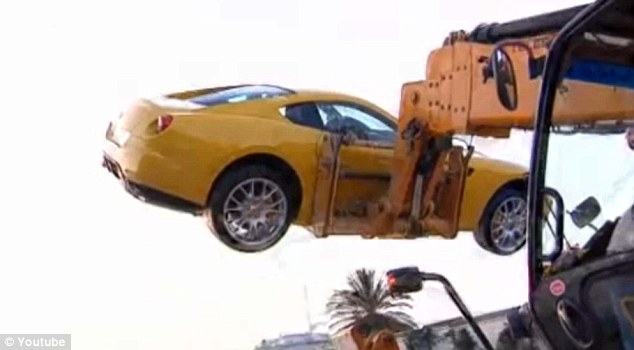
Now that's what you call looting: Tunisians steal ousted president's £125,000 Ferrari using a FORKLIFT TRUCK

While most looters resort to taking home whatever they can carry in their arms, these Tunisian thieves employed a slightly more enterprising approach… using a forklift truck.

They used the industrial vehicle to pick up one of ousted former President Zine El Abidine Ben Ali's Ferraris from its parking space and then simply drove off with the supercar dangling from the forks.

One looter riding in the JCB was seen grinning as he sped along a highway in the capital Tunis with the 599 GBB Fiorano, which cost £125,000 when new four years ago.

Leila Trabelsi. the former president's wife, was known for her love of fast cars - the family had more than 50 - and widely despised as the ultimate symbol of corruption and excess.

Dubbed ‘the Imelda Marcos of the Arab world’ the former hairdresser, 53, was also known for her luxury homes and frequent shopping trips to Dubai, during which she is said to have spent hundreds of thousands of pounds.


Easy picking: A looter in a JCB forklift truck drives off with a Ferrari belonging to Zine el-Abidine Ben Ali

Thumbs up: Thieves in the truck's cab show their delight at taking the supercar in Tunisian capital Tunis

Finders, keepers: The thieves thought nothing of driving down the road with the Ferrari in broad daylight

Continue reading - Now that's what you call looting: Tunisians steal ousted president's £125,000 Ferrari using a FORKLIFT TRUCK

Ron Paul 2012 - Can you Hear us Now?

The Revolution is alive and well!

Ron Paul 2012 - Can you Hear us Now?

Friday, January 28, 2011

YEMEN REVOLT - Thousands in Yemen Protest Against the Government


BEIRUT, Lebanon — Yemen, one of the Middle East’s most impoverished countries and a haven for Al Qaeda militants, became the latest Arab state to witness mass protests on Thursday, as thousands of Yemenis took to the streets in the capital and other regions to demand a change in government.

The scenes broadcast across the Arab world were reminiscent of demonstrations in Egypt this week and the month of protests that brought down the government in Tunisia. But as they climaxed by midday, the marches appeared to be carefully organized and mostly peaceful, though there were reports of arrests by security forces. Predictably, the protests were most aggressive in the restive south.

In Sana, at least 10,000 protesters led by opposition members and youth activists gathered at Sana University, and around 6,000 more gathered elsewhere, participants, lawmakers and activists reached by telephone said. Many carried pink banners and wore pink headbands.

The color was both a unifying symbol and an indication of the level of planning underlying the protests. Weeks ago, as the Tunisian protests were still escalating, a committee from an umbrella group of six opposition parties settled on an escalating scale of color to accompany their own plan of action, starting with purple for lawmakers to show their opposition and moving to pink for the street protests. Red, said Shawki al-Qadi, a lawmaker and opposition figure, would be the final color, though he said the opposition had not yet decided what actions would correspond with the move.

“I fear Yemen is going to be ripped apart,” said Mohammed Naji Allaw, coordinator of the National Organization for Defending Rights and Freedom, which was one of the organizers of the protests. “The situation in Yemen is a lot more dangerous than in any other Arab country.”

In a televised speech on Sunday night, Mr. Saleh tried to defuse calls for his ouster, denying opposition claims that his son would inherit his power — as has happened in Syria and, some fear, may occur in Egypt. He said he would raise army salaries, a move that appeared designed to ensure soldiers’ loyalty. Mr. Saleh has also cut income taxes in half and ordered price controls.

Unlike Tunisia and Egypt, relatively stable countries with substantial middle classes and broad access to the Internet, Yemen is among the poorest countries in the Middle East.

“People do have fair grievances everywhere in Yemen, but unfortunately they are being used by politicians from both sides,” the deputy finance minister, Jalal Yaqoub, told Reuters on Thursday, adding that the government “should listen to the people and enact substantial reforms.”

Continue reading - NY Times - Thousands in Yemen Protest Against the Government

[Yemen] Mass Protest Today 27.01.11


Thousands Demand Ouster Of Yemen's President


Thousands Protest in Sanaa, Yemen 2011 - January 27 Raw Video

Cameron Says U.K. Is Determined to Kill Off Debt `Specter'


Prime Minister David Cameron will reassert his commitment to eliminating Britain’s budget deficit amid criticism that his plans are choking economic recovery.

British banks, households and the government all need to reduce their indebtedness to restore a balanced economy, Cameron will tell the World Economic Forum in Davos, Switzerland today.

“Our first priority is to kill off the specter of massive sovereign debts,” Cameron will say, according to remarks released by his office in London. “We can’t just flick on the switch of government spending or pump the bubble back up.”

Cameron is fighting back against warnings that his plan to almost eliminate the deficit within four years is too severe. Critics including billionaire investor George Soros say the squeeze is sapping economic confidence just as accelerating inflation puts pressure on the Bank of England to end its emergency stimulus.

Britain’s economy unexpectedly shrank 0.5 percent in the final three months of 2010 as the coldest December in a century hampered services and retailing, data this week showed. That suggests the recovery faded even before Cameron’s government implements the fiscal squeeze, the largest since World War II.

Soros Warning

Soros, who reportedly made $1 billion selling the pound in 1992, said this week that the government will have to rethink its budget deficit-cutting plan or risk pushing the economy back into recession. Cameron’s plan cannot “possibly be implemented without pushing the economy into a recession,” Soros said.

Chancellor of the Exchequer George Osborne, who also speaks at the Davos gathering today, will hit back at criticism from the opposition Labour Party by warning that its policies left Britain more indebted than most other major nations.

“Over the last decade our economy became perhaps the most extreme example of any major economy of the dangerous imbalances that now need to be unwound,” Osborne will say, according to extracts of his speech released by the Treasury.

‘Illusion of Growth’

Britain experienced “the biggest housing boom, the most leveraged banks, the most indebted households, the biggest budget deficit,” Osborne will say. “An illusion of growth built on easy money that has now turned to dust. Adjustment will not be without struggle.”

*Sound familiar? Henry Hazlitt indeed warned in Economics in One Lesson (1946) -
"The ardor for inflation never dies. It would almost seem as if no country is’ capable of profiting from the experience of another and no generation of learning from the sufferings of its forbears. Each generation and country follows the same mirage. Each grasps for the same Dead Sea fruit that turns to dust and ashes in its mouth. For it is the nature of inflation to give birth to a thousand illusions."

Cameron will say that without determined action to cut the deficit, higher real interest will prevent a recovery from materializing.

Continue reading - Bloomberg - Cameron Says U.K. Is Determined to Kill Off Debt `Specter'

Thursday, January 27, 2011

Bank of England chief Mervyn King: Standard of living to plunge at fastest rate since 1920s


Households face the most dramatic squeeze in living standards since the 1920s, the Governor of the Bank of England warned, as he reacted to the shock disclosure that the economy was shrinking again.

Families will see their disposable income eaten up as they “pay the inevitable price” for the financial crisis, Mervyn King warned.

With wages failing to keep pace with rising inflation, workers’ take- home pay will end the year worth the same as in 2005 — the most prolonged fall in living standards for more than 80 years, he claimed.

Mr King issued the warning in a speech in Newcastle upon Tyne after official figures showed that gross domestic product fell by 0.5 per cent during the final three months last year. The Government blamed the unexpected reduction — the first since the third quarter of 2009 — on the freezing weather that paralysed much of the country last month.

But there were fears that the country was poised to slip back into recession, defined as two successive quarters of negative growth. Economists said the situation was “an absolute disaster”.

Mr King said he was unable to offer any imminent hope of a rise in interest rates in coming months because of the poor economic outlook. Savers and “those who behaved prudently” would be among the biggest losers in the squeeze, he admitted.

The governor warned that the Bank “neither can, nor should try to, prevent the squeeze in living standards”.

He said that the economic figures were a reminder that the recovery will be “choppy”. However, he said the biggest threat facing the Bank’s Monetary Policy Committee, which sets interest rates, was rising inflation.

Mr King insisted that the Monetary Policy Committee could not have increased interest rates from their current record low level to tackle the rise in inflation.

“The erosion of living standards would have been even greater. The idea that the MPC could have preserved living standards, by preventing the rise in inflation without also pushing down earnings growth further, is wishful thinking.”

Mr King expressed sympathy for savers and highlighted the failure of lenders to pass on cuts in interest rates. “I sympathise completely with savers and those who behaved prudently now find themselves among the biggest losers from this crisis,” he said. “But a return to economic stability from our fragile condition will require careful and well-judged steps looking beyond the next few months.”

Continue reading - Bank of England chief Mervyn King: standard of living to plunge at fastest rate since 1920s

Ron and Rand Paul Introduce “Audit the Fed” Legislation in House and Senate


Congressman Ron Paul and his son, Senator Rand Paul, today introduced companion legislation in both chambers of the United States Congress to require a full and thorough audit of the Federal Reserve.

The bills, both titled The Federal Reserve Transparency Act of 2011, but known better as “Audit the Fed,” are numbered H.R. 459 in the House and S. 202 in the Senate and continue the efforts championed by Ron Paul last year that won 320 co-sponsors before passing the House and 32 cosponsors in the Senate before falling short on a floor vote.

H.R. 459 starts the session with 56 original bipartisan cosponsors, while Sen. Jim DeMint (R-SC) and Sen. David Vitter (R-LA) are original cosponsors for S. 202.

The Federal Reserve Transparency Act of 2011 would open up the Fed’s funding facilities, such as the Primary Dealer Credit Facility, Term Securities Lending Facility, and Term Asset-Backed Securities Lending Facility to Congressional oversight and audit by the non-partisan Government Accountability Office. Additionally, audits would include discount window operations, open market operations, and agreements with foreign central banks such as ongoing dollar swap operations with European central banks.

Public polling conducted by Rasmussen Reports in December 2010 indicated that 74 percent of the American People demand transparency at the Fed and support a full audit as called for in the Audit the Fed legislation. In 2009 and 2010, Campaign for Liberty generated over 2.5 million grassroots contacts to federal lawmakers in support of Audit the Fed.

“The Federal Reserve and its loose money, easy credit policies are the culprit for so many of the dire economic problems we face. Americans continue to demand transparency at the Federal Reserve, and Campaign for Liberty is proud to lead the fight to make this legislation the Law of the Land,” said Campaign for Liberty President John Tate. “All across the country, grassroots citizens are uniting behind Ron and Rand Paul and will demand this audit, this year.”

Source: Ron and Rand Paul Introduce “Audit the Fed” Legislation in House and Senate

House.gov - Audit the Fed Reintroduced

Wednesday, January 26, 2011

DOCUMENTARY OF THE YEAR! ZEITGEIST: MOVING FORWARD

Zeitgeist: Moving Forward, by director Peter Joseph, is a feature length documentary work which will present a case for a needed transition out of the current socioeconomic monetary paradigm which governs the entire world society.

This subject matter will transcend the issues of cultural relativism and traditional ideology and move to relate the core, empirical "life ground" attributes of human and social survival, extrapolating those immutable natural laws into a new sustainable social paradigm called a "Resource-Based Economy".

ZMF GLOBAL/LOCAL THEATRICAL RELEASE RESULTS

ZEITGEIST: MOVING FORWARD | OFFICIAL RELEASE | 2011


INTERVIEW:

Zeitgeist Moving Forward Press Conference


Artivist "Zeitgeist" Los Angeles Premiere with Peter Joseph


Why I Advocate The Zeitgeist Movement

Tuesday, January 25, 2011

Ron Paul: "The Federal Reserve Is Responsible For The Inflation, The Business Cycle, Unemployment!"

Ron Paul "The Federal Reserve Is Responsible For The Inflation, The Business Cycle, Unemployment!"

EGYPT REVOLT - Egypt activists to hold Tunisia-inspired 'action day'


Anti-government activists in Egypt are preparing for a rare day of protest, inspired by the recent political upheaval in Tunisia.

Organisers have called for a "day of revolt against torture, poverty, corruption and unemployment".

But the government has warned they face arrest and is calling its supporters out in a counter-demonstration.

"Our protest on the 25th is the beginning of the end," Reuters quoted the organisers as saying.

"It is the end of silence, acquiescence and submission to what is happening in our country. It will be the start of a new page in Egypt's history - one of activism and demanding our rights."

Egypt has many of same social and political problems that brought about the unrest in Tunisia - rising food prices, high unemployment and anger at official corruption.

Continue reading - BBC - Egypt activists to hold Tunisia-inspired 'action day'

UPDATE on 25th Jan - Egyptian Police Confront Protesters


Thousands of protesters clashed with the police in the Egyptian capital on Tuesday as antigovernment activists energized by events in Tunisia sought to transform Police Day, a national holiday, into a “day of revolution.”

The demonstrators quickly swelled in number as they snaked through winding streets and converged on the central Tahrir Square, where they met security forces in full riot gear and a water cannon truck. Clashes began after protesters jumped on the truck and tried to take control of it.

Thousands occupied the square, hurling rocks and beating back several attempts by security forces to disperse them with tear gas. Some in the security force stooped to pick up the rocks and hurl them back at the protesters. A few protesters were seen dismantling a fire truck.

The marchers included young people documenting the clashes with cellphone cameras and middle-aged men carrying flags of the Wafd party, one of Egypt’s opposition groups. Women, some in headscarves and some bareheaded, also marched.

The protesters echoed the deep-seated frustrations of an enduring, repressive government that drove Tunisians to revolt: rampant corruption, injustice, high unemployment and the simple lack of dignity accorded them by the state. At least six young Egyptians have set themselves on fire in recent weeks, in an imitation of the self-immolation that set off the Tunisian unrest.

The antigovernment demonstration appeared to be among the largest to hit Cairo since 1977, when riots forced the government to back down from an increase in the price of bread.

“Freedom, freedom, freedom,” they chanted. “Where are the Egyptian people?”

Protests have also erupted in other Arab nations including Algeria, Morocco and Yemen, which face similar problems of high unemployment and rising living costs. The demonstrations today were organized on Facebook, with about 90,000 people signing up to protests, and some of those attending the Cairo rally waved Tunisian flags. There were smaller protests in Alexandria.

Continue reading - NY Times - Egyptian Police Confront Protesters

Protest in Egypt - Jan 25, 2011


Thousands of anti-government protesters gather in Cairo, Egypt


Egypt police fire tear gas as rioting erupts in Cairo


Large Protests Erupt In Egypt


Crowd chanting "Revolution, Revolution until victory"


Crowd in downtown Cairo chanting "The fall of the regime is what the people want"


UPDATES:

RECOMMENDED! Egyptian Revolution Jan 25th 2011 - Take what's Yours!


Egypt Revolution? Video of deadly anti-Mubarak protests in Cairo


Egypt protests breaking new ground.


Raw Video: Egypt Protesters Clash With Police

ALBANIA RIOTS - Cars torched, cops stoned, 3 dead

In the Albanian capital Tirana, at least three people have been shot dead and several others injured during a rally. Thousands of protesters gathered outside the Prime Minister's office demanding the government step down over corruption allegations. Police used tear gas and water cannons to disperse the crowds who called for fresh elections. The country has been in a political deadlock since the opposition rejected the result of the ballot two years ago.

Video of angry riots in Albania: Cars torched, cops stoned, 3 dead

Monday, January 24, 2011

Global Price Fears Mount


Inflation fears—fueled by spiraling food, oil and raw material prices—are mounting around the globe, prompting the head of the European Central Bank to signal that it could raise interest rates in the future even though some countries have been weakened by the Continent's debt crisis.

In an interview with The Wall Street Journal ahead of this week's annual meeting of the World Economic Forum in Davos, Switzerland, Jean-Claude Trichet warned that inflation pressures in the euro zone must be watched closely, and urged central bankers everywhere to ensure that higher energy and food prices don't gain a foothold in the global economy.

Mr. Trichet's warning comes at a time when inflation concerns are mounting among investors around the world. Fast-growing emerging markets such as China and Brazil are seeing rising inflation at home, and their demand for globally traded commodities is pushing prices higher elsewhere.

While high unemployment and spare capacity are restraining underlying inflation pressures in the U.S. and elsewhere in the developed world, annual inflation in China is almost 5%—and a sizzling 9.8% economic growth rate in the fourth quarter triggered fears of more price pressures ahead. Inflation in Brazil is even higher.

"All central banks, in periods like this where you have inflationary threats that are coming from commodities, have to…be very careful that there are no second-round effects" on domestic prices, said Mr. Trichet in his office overlooking Frankfurt's financial district.

Global inflation isn't just coming from volatile commodities that track the ups and downs of the world economy. Fast-growing emerging nations are taking increasingly aggressive actions to beat back rising food prices as they grow more worried about threats to stability.


"All countries in the euro area have an immense stake in the solid anchoring of inflation expectations," he said.

Continue reading - WSJ - Global Price Fears Mount

Saturday, January 22, 2011

Sue The Fed


Why Sue the Federal Reserve?

* To End the "Rule of the Banks" over the People and Bring Accountability to Wall Street
* To Restore Economic Prosperity and a Sustainable Monetary Policy
* To Recover Trillions of Dollars Taken from "We the People"
* To Reduce the Federal Deficit by Trillions of Dollars
* To Obtain Economic Justice for All Americans


The Fed is beyond redemption and must be abolished for the following reasons:

1. Unconstitutionality: Many legal experts insist that the Federal Reserve Act is unlawful on its face under Article I Section 8 of the US Constitution; and that Congress acted beyond its authority when it chartered the Fed in 1913.
2. Unfairness: The current system allows banks the ability to loan money they do not have, created in transactions where they put nothing at risk thus assigning all of the risks in the loan to be borne by the borrower. As many authors state – it is like “creating money from nothing.” This practice is unjust and unconscionable. It is simply un-American to get something for nothing.
3. Lack of Transparency: The Fed fails to disclose its banking practices and the ultimate results of its monetary policies to borrowers prior to making its interest-bearing loans. In the opinion of our counsel their failure to disclose these fundamental aspects of borrowing are unlawful - termed “fraud in the inducement” and if the court agrees, these transactions are actionable (provide a cause to sue).
4. Public Endangerment: Numerous experts have shown that any monetary policy which calls for the payment of interest to a private bank based upon the government’s debt (defined as “Usury”) creates an economy that is mathematically unsustainable and which is inherently designed to fail. This fundamental flaw undermines our society, weakens our economy, threatens our national security and damages each and every Person in the nation. The evidence of this truth is everywhere today – where economies all over the world (Argentina, Greece, Iceland, etc) are collapsing and being forced into bankruptcy by the large international banks and their central banks that operate on the same Usury system principles. (We believe that the United States may not be far behind unless something is done immediately to stop it.)
5. Unregulated Monopoly: The Fed has grown so powerful that it no longer allows any true oversight by Congress. For example, the Fed has never undergone a complete audit and now openly refuses to allow one. The Fed is no longer cooperating with Congress and is steadfastly refusing to answer important questions regarding our money and the material transactions it makes on a regular basis. We believe that no institution should be allowed to operate beyond oversight and above the law.
6. Against Public Policy: Because the Fed makes enormous profits by putting the government (i.e., every one of us) into a state of perpetual re-borrowing and interminable debt, the Fed’s policies are unconscionable; and act against our best interests and violate the public trust of the American people.
7. Breach of Fiduciary Duty: The Fed has failed to meet its stated goals in its charter which are to: “to provide the nation with a safer, more flexible, and more stable monetary and financial system.” In fact, since 1913 the Fed’s policies have actually caused the exact opposite to occur:
i. The dollar has lost 95% of its value,
ii. Our economy has experienced numerous recessions and a major depression,
iii. Our economy is now on the verge of total financial collapse,
iv. The federal government has accumulated massive debts which it is entirely unable to repay without continued re-borrowing (we are essentially bankrupt), and
v. Americans are losing their personal property at unprecedented rates (record bankruptcies and foreclosures) and seeing a relentless erosion of their individual freedoms and liberty every day.


Source: SueTheFed.com