If I have seen further it is by standing on the shoulders of giants.

Sunday, December 12, 2010

The Fed? Ron Paul’s Not a Fan


Ben S. Bernanke, the chairman of the Federal Reserve, has been attacked for failing to foresee the financial crisis, for bailing out Wall Street, and, most recently, for injecting an additional $600 billion into the banking system to give the slow recovery a boost.

But Mr. Bernanke will face even more scrutiny in the months to come. On Thursday, House Republican leaders announced that Representative Ron Paul of Texas, the outspoken Republican libertarian who ran for president in 2008, will become the chairman of the subcommittee that oversees the Fed. His position on the central bank is captured in the title of his 2009 book, “End the Fed” (Grand Central Publishing).

Here’s some of what he wrote:

The Beginning of the End

“The day the Fed came into being in 1913 may have been the beginning of the end, but the powers it obtained and the mischief it caused took a long time to become a serious issue and a concern for average Americans.”

The Gold Standard

“Whenever I talk of a gold standard, there are always people ready to accuse me of having some obsession or fixation. Fetish is a word thrown around. In fact, I’m only observing reality: the idea of sound money in most of human history has been bound up with gold money.”

A Full-Time Counterfeiting Operation

On Mr. Bernanke: “There is something fishy about the head of the world’s most powerful government bureaucracy, one that is involved in a full-time counterfeiting operation to sustain monopolistic financial cartels, and the world’s most powerful central planner, who sets the price of money worldwide, proclaiming the glories of capitalism.”

New Money Out of Thin Air

“Only the Federal Reserve can inflate the currency, creating new money and credit out of thin air, in secrecy, without oversight or supervision. Inflation facilitates deficits, needless wars and excessive welfare spending.”

Fed Chairmen He Has Known

“Being in Congress in the late 1970s and early 1908s and serving on the House Banking Committee, I met and got to question several Federal Reserve chairmen: Arthur Burns, G. William Miller and Paul Volcker. Of the three, I had the most interaction with Volcker. He was more personable and smarter than the others, including the more recent board chairmen Alan Greenspan and Ben Bernanke.”

Low Interest Rates

“Artificially low interest rates are achieved by inflating the money supply, and they penalize the thrifty and cheat those who save. They promote consumption and borrowing over savings and investing. Manipulating interest rates is an immoral act. It’s economically destructive.”

The Bailouts

“Today, there is no principled opposition to the corporate bailouts and the Fed’s trillions of dollars of new credit and the takeover of insurance, mortgages, medical care, banks and the auto industry. The arguments have only been over amounts, financial vehicles, and which political group gets to wield the economic power. If there is no moral argument against the economic takeover of America, there will be no resistance to the dictator who rules over our lives with an iron fist.”

The Obama Legacy

“For the same reason a disease cannot be cured by more of the germ that caused it, the inflation and debt accumulation of the Obama years will not inflate our way out of it. This depression will likely last and last.”

Continue reading - NY Times - The Fed? Ron Paul’s Not a Fan

Saturday, December 11, 2010

Fed Overseer Ron Paul Says He Doubts Bernanke Can Prevent Inflation Surge


Representative Ron Paul, a Texas Republican who next month will take control of the House subcommittee that oversees the Federal Reserve, said he’s concerned the central bank won’t be able to prevent an outbreak of inflation.

Fed Chairman Ben S. Bernanke said during an interview broadcast Dec. 5 on CBS Corp.’s “60 Minutes” he was “100 percent” confident the Fed could keep inflation below 2 percent and reverse its accommodative monetary policy when necessary. Policy makers “could raise interest rates in 15 minutes,” if needed, he said.

“This optimism of Bernanke who says that when the prices start to go up, he can turn that off in 15 minutes, I don’t think he fully understands the subjective theory of value and how prices have a psychological reason for going up, too,” Paul said today on Bloomberg Radio’s “The Hays Advantage” with Kathleen Hays. “When people lose confidence, prices go up, and you can’t turn that psychology off in a minute”

Continue reading - Bloomberg - Fed Overseer Ron Paul Says He Doubts Bernanke Can Prevent Inflation Surge

Dr. Ron Paul on Fox & Bloomberg 12/10/10

Congressman Ron Paul interviewed on Friday concerning his subcommittee and the Fed's actions during the economic crisis.

Ron Paul on Fox Business December 10 2010


Ron Paul on Bloomberg December 10 2010

Friday, December 10, 2010

Ron Paul, Author of `End the Fed,' to Lead Panel Overseeing Central Bank


Representative Ron Paul, Texas Republican and author of “End the Fed,” will take control of the House subcommittee that oversees the Federal Reserve.

“This is the leadership team that crafted the first comprehensive financial reform bill to put an end to the bailouts, wind down the taxpayer funding of Fannie Mae and Freddie Mac, and enforce a strong audit of the Federal Reserve,” Bachus said in a statement.

Paul, in an interview last week, said he plans a slate of hearings on U.S. monetary policy and will restart his push for a full audit of the Fed’s functions.

“We are ready to hit the ground running, and I look forward to continuing our work in the next Congress,” Bachus said.

Paul, who has introduced legislation to abolish the Fed, became nationally known during his 2008 presidential campaign. His campaign to audit the Fed picked up steam as the central bank deployed trillions of dollars in emergency loans in the midst of the worst financial crisis since the Great Depression. Paul’s bill gained the support of 320 of 435 members of the House and a portion of the measure ended up in the Dodd-Frank financial regulatory overhaul enacted this year.

“Congress must act to rein in Chairman Bernanke and the Fed before they destroy our currency and permanently damage our economy and financial system,” Senator Jim Bunning, a Kentucky Republican, said in his farewell speech on the Senate floor today. “Public awareness of what the Fed is doing is increasing while public opinion of the Fed is falling.”

Bunning’s views are reflected throughout the country, according to a Bloomberg National Poll that reveals deep skepticism about the Fed.

Continue reading - Bloomberg - Ron Paul, Author of `End the Fed,' to Lead Panel Overseeing Central Bank

More Than Half of Americans Want Fed Reined In or Abolished


A majority of Americans are dissatisfied with the nation’s independent central bank, saying the U.S. Federal Reserve should either be brought under tighter political control or abolished outright, a poll shows.

The Bloomberg National Poll underlines the extent to which the central bank’s standing has suffered as it has come under fire in Congress, first from Democrats for regulatory lapses before the financial crisis and then from Republicans for failing to revive an economy in which the jobless rate hovers near 10 percent. Voters from both parties have criticized the Fed’s $3.3 trillion in aid to the financial system.

Americans across the political spectrum say the Fed shouldn’t retain its current structure of independence. Asked if the central bank should be more accountable to Congress, left independent or abolished entirely, 39 percent said it should be held more accountable and 16 percent that it should be abolished. Only 37 percent favor the status quo.

In a previous poll, conducted Oct. 7-10, 35 percent of Americans said the Fed should be radically overhauled, while 8 percent said it should be abolished.

Republicans and independents are more likely to support ending the Fed, with 19 percent of independents, 16 percent of Republicans, and 12 percent of Democrats wanting to do away with the central bank. Among those who identify themselves as supporters of the Tea Party movement, which wants to rein in government, 21 percent want to abolish the Fed.

Continue reading - Bloomberg Poll - More Than Half of Americans Want Fed Reined In or Abolished

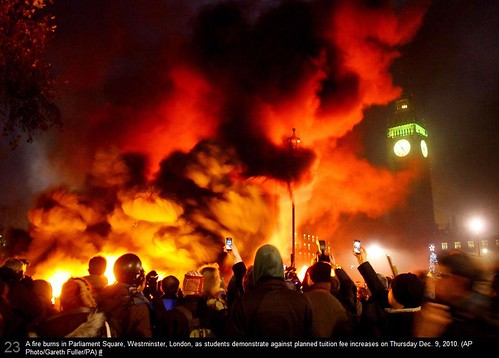
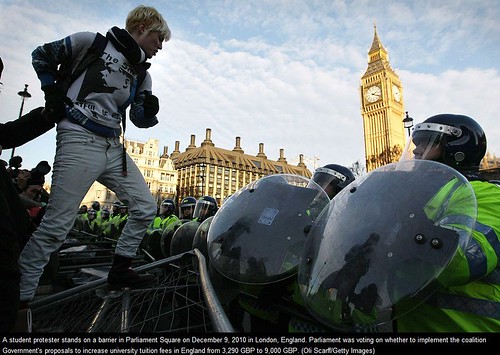
THIRD WAVE REVOLT - British Students Protest as Tuition Hike Is Debated


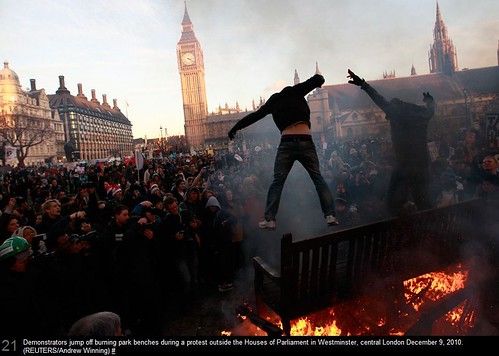
Police clashed with protesters during a demonstration against plans to raise tuition fees for university students, in London on Thursday.

LONDON (AP) — Police with riot shields and batons pushed angry student protesters away from London's Parliament Square on Thursday as lawmakers debated a controversial plan to triple university tuition fees in England.

Thousands of students held demonstrations and sit-ins throughout the country, heaping pressure on the government to reverse course.

Throwing flares, billiards balls and paint bombs, small groups of protesters tore down barricades as police attempted to reinforce a security cordon near Parliament. Two police officers were injured_one seriously_in the fracas and two protesters were arrested for assaulting officers, police said.

The scuffles broke out after students marched through central London and converged on the square, waving placards and chanting "education is not for sale," capping weeks of nationwide protests to pressure lawmakers to reverse course.

The tuition vote poses a crucial test for both the Conservative's governing coalition with the Liberal Democrats and the government's austerity plans to reduce Britain's budget deficit.

Students have said the concessions are not enough to lessen the blow of higher fees. They say that under the proposal, piles of debt will plague graduates and make a well-rounded education unattainable for many.


Continue reading - NY Times - British Students Protest as Tuition Hike Is Debated

More pictures here -
PROTEST GALLERY 1
PROTEST GALLERY 2
PROTEST GALLERY 3

Reuters(25 pics) - Clashes as parliament votes for student fee rise

BBC - Violence flares at Westminster as MPs debate fee rises

BBC - Students removed from Belfast road protest

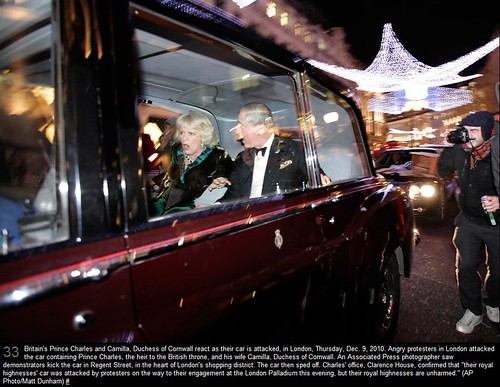
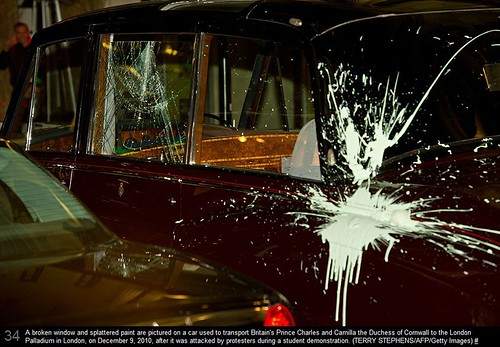
BBC - Royal car attacked in protest after MPs' fee vote

BBC - Prince Charles and Duchess of Cornwall unhurt in attack

Fee Not: London's biggest protest as students march for justice


Rotten Fruit: London scene of massive student fury


Raw Video: Angry Protesters Surround Parliament


Protesters Attack Prince Charles And Camilla's Car

Thursday, December 9, 2010

Dead Cat Bounce - Bernanke Dumber Than Gold - Get Out Of Stocks

Dead Cat Bounce - Bernanke Dumber Than Gold - Get Out Of Stocks - Mike Maloney

“Fraud as a Business Model”

“Fraud As a Business Model”, the slides from Tavakoli's presentation delivered today to the Federal Housing Finance Agency’s Supervision Summit.

From one of the slides:
• Investment banks – securities fraud
• Mortgage lenders – widespread fraud
• Rating agencies – junk science
• CDO “managers” – crash test dummies & accomplices
• Certain hedge funds – shorted CDOs they “managed”
• Bond insurers – money for nothing
• Regulators – poseurs and enablers


FHFA1282010

Tuesday, December 7, 2010

Fed Chairman Bernanke On The Economy

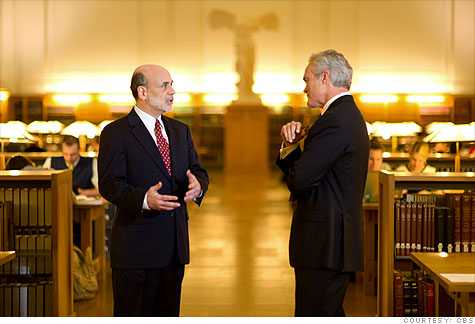
Fed Chairman Ben Bernanke gives a rare interview to Scott Pelley in which he discusses pressing economic issues, including unemployment, the deficit and the Fed's controversial $600 billion U.S. Treasury Bill purchase.

Fed Chairman Bernanke On The Economy


OUTRIGHT LIES!

Saturday, December 4, 2010

'RM544m bond means Sabah has no liquid cash'


The Sabah government recently declared that the controversial “bond” it issued in 2009 was part of its revenue in the state 2010 Budget.

Firstly be reminded that the state issued two bonds and not one. The earlier one was the RM500 million bond issued by the Sabah Development Bank. The second RM544 million bond was issued by the Sabah Ministry of Finance.

I’m just going to simplify the issue and focus on the RM544 million borrowed from the State Ministry of Finance.

The Sabah Ministry of Finance in 2009 initiated the issuance of government bond worth RM544 million, which is to mature in 2014 at a capped rate of 5%.

Amortisation of this bond requires the sabah government to pay RM615 million, with a monthly payment of RM10.27 million or RM123.24 million. Total cap-on will be RM71.96 million


Placing the debt in the revenue column is a trick, which makes the state government deficit expenditure look small.

This is a way of hiding the real deficit, which would otherwise be too huge to be in the picture and not sustainable

This method of accounting would serve as the easiest and convenient way to get new money.

In simple term, the whole state can and is good for “pawning off” or in local terms “pajak gadai”.

By default this means that the whole of Sabah can be put up for sale.

If Sabah is as rich as claimed by Sabah Chief Minister Musa Aman, with a reserve of RM2 billion, why does the state need to raise this bond and give away the RM71.96 million for no reason?

The only plausible explanation is that the RM2 billion is fixed asset – not liquid cash. Therefore the bond is used as cash reserve meant for paying emoluments (a state governments needs eight months in reserves).

Don’t forget the state government has yet to pay more than RM1 billion on water bills to Jetama Air. This should give us some idea if the state government is financially sound as portrayed.

This is a wrong way of solving payment of emoluments. The Ministry of Finance has purposely exposed Sabah to unnecessary default risk, while there are no changes to the capacity and capability of the state institutions.

This confirms the view that the state is stagnating on purpose. The people are made to believe rhetoric and hang on to palliatives.

There’s no concerted effort to develop Sabah to be at par with the other states in the country.

By putting bond as revenue, Musa, who is also the State Minister of Finance, had deliberately lied to the people on the health of Sabah's revenue.

Continue reading - Sabah - 'RM544m bond means Sabah has no liquid cash'

Bernanke Doesn't Rule Out QE Exceeding $600 Billion


Federal Reserve Chairman Ben S. Bernanke defended the Fed’s decision to purchase $600 billion in Treasury securities and didn’t rule out expanding the program, in an interview for CBS television’s “60 Minutes,” the network said.

“He explains why the Fed announced its intention to buy $600 billion in Treasury securities, defending against charges the move will lead to inflation and not ruling out the purchase of more,” according to a press release today from CBS.

At its Nov. 3 meeting in Washington, the Fed announced the program to purchase about $75 billion a month of Treasury securities through June. The Fed’s Open Market Committee said it would “regularly review the pace of its securities purchases and the overall size of the asset-purchase program.”

Republican leaders criticized the second round of so-called quantitative easing last month, where the Fed attempts to provide additional monetary stimulus by purchasing Treasury debt. The Fed’s benchmark lending rate has been in a range of zero to 0.25 percent since December 2008.

Continue reading - Bloomberg - Bernanke Doesn't Rule Out QE Exceeding $600 Billion

Thursday, December 2, 2010

Tom Woods at Illinois State University, Nov.17, 2010

Tom Woods, author of the bestselling book - Meltdown, spoke at Illinois State University on November 17, 2010. The event was sponsored by Campaign for Liberty and the ISU chapter of Young Americans for Liberty.

Thomas Woods Meltdown Introduction


Thomas Woods Meltdown Part 1


Thomas Woods Meltdown Part 2


Thomas Woods Meltdown Part 3


Thomas Woods Meltdown Part 4


Thomas Woods Meltdown Part 5


Thomas Woods Meltdown Part 6

Fed to Name Recipients of $3.3 Trillion in Aid During Crisis


The Federal Reserve, under orders from Congress, plans today to identify recipients of $3.3 trillion in emergency aid the central bank provided as it fought the worst financial crisis since the Great Depression.

The Fed intends to post the data on its website at midday in Washington to comply with a provision in July’s Dodd-Frank law overhauling financial regulation. The information spans six loan programs as well as currency swaps with other central banks, purchases of mortgage-backed securities and the rescues of Bear Stearns Cos. and American International Group Inc.

The disclosures may heighten political scrutiny of the central bank already at its most intense in three decades. The Fed’s Nov. 3 decision to add $600 billion of monetary stimulus has met with backlash from top Republicans in Congress, who said in a Nov. 17 letter to Chairman Ben S. Bernanke that the action risks inflation and asset-price bubbles.

Continue reading - Bloomberg - Fed to Name Recipients of $3.3 Trillion in Aid During Crisis

Federal Reserve - FRB - Usage of Federal Reserve Credit and Liquidity Facilities

Congressman Paul discusses the Fed and bailouts

UN: World recovery slows, will be hit by austerity

The world's recovery from the 2008 financial crisis is losing steam, with growth, hit by austerity drives in rich countries, not enough to restore the 30 million lost jobs in the next two years, the United Nations said on Wednesday.

"The road to recovery from the Great Recession is proving to be long, winding and rocky," said an annual U.N. survey, "World Economic Situation and Prospects 2011."

"After a year of fragile and uneven recovery, growth of the world economy is now decelerating on a broad front, presaging weaker global growth in the outlook."

"The core message is that no, we're not out of the woods yet and still major risks are looming," the report's lead author, Rob Vos, told reporters.

Weaknesses in developed economies, including sluggish growth in the United States and debt crises on the periphery of Europe, were dragging down the global recovery and posing risks for world economic stability, it said.

"There will be no quick fix for the problems these economies are still facing in the aftermath of the (2008) financial crisis," it said.

The report implicitly faulted nations that have dropped stimulus packages in favor of slashing budgets. "As governments shift from fiscal stimulus to austerity, the recovery process is being placed in further jeopardy," it said.

"Withdrawal of stimulus is understandable given the large fiscal deficits and the mounting public debt in many of the developed countries, but at the same time we see there's still a lot of fiscal space available for more stimulus," Vos said.

Focusing on debt reduction without stimulus could be a "self-defeating strategy" because failing growth rates could worsen debt problems, he said.

The report also queried the policy of "quantitative easing" -- or pumping money into the economy by buying government debt. The U.S. Federal Reserve announced a program on November 3 to buy $600 billion in government bonds by mid-2011.

"Further quantitative easing and a further depreciation of the dollar could be a way for the United States to try to inflate and export its way out of its large foreign liability position," the report said. "But it could more likely risk disruption of trade and financial markets."

Continue reading - Reuters - UN: World recovery slows, will be hit by austerity