On February 10, over a thousand gathered at the Marriott Wardman Hotel in Washington D.C. for Campaign for Liberty's "Liberty Forum 2011" at the Conservative Political Action Conference (CPAC).
Speakers included YAL Executive Director Jeff Frazee, Campaign for Liberty President John Tate, New York Times Bestselling Author Tom Woods, Talk radio host Jack Hunter, Congressman Ron Paul, and Senator Rand Paul.
CPAC 2011: Liberty Forum Pt.1
CPAC 2011: Liberty Forum Pt.2
CPAC 2011: Liberty Forum Pt.3
CPAC 2011: Liberty Forum Pt.4
Friday, February 18, 2011

MIDDLE EAST REVOLT - Egyptian Revolution Spreads to Libya and Bahrain
Rising food prices were one reason behind the wave of anti-government demonstrations in North Africa and the Middle East. The UN has warned of impending social upheaval in countries that are quite literally hungry for freedom. The issue is also creeping into the U.S. where food stamp programmes are being slashed.
Hungry for Freedom: Plight of poor behind street rage as system raises food prices
In the Middle East, anti-government demonstrations have spread to Libya with hundreds of people taking to the streets in the first sign of the country's unrest. The uprisings in Tunisia and Egypt have triggered a domino effect of protests calling for reform across the Arab world. Two protesters in Bahrain were killed and several others wounded in violence there. Police had to use tear gas and batons to disperse the crowds. In Iran, members of Parliament called for the execution of opposition leaders they say orchestrated protests on Monday that saw two people killed. President Ahmadinejad also vowed to punish the organisers, while the U.S. strongly backed the opposition. Egypt itself is gripped by labour strikes, where interim power is now in the hands of the military which is reworking the constitution. But some experts believe with the ideological splits, the army leadership has more to worry about from U.S. interference.
Violent protests in Iran, Bahrain as Egypt Army 'split between business & military'
Revolt Fever: Libya joins protest club as wave of wrath sweeps Arab world
Video of deadly Bahrain protests as violence escalates in Manama
Protesters clash with police in Benghazi, Libya
Hungry for Freedom: Plight of poor behind street rage as system raises food prices
In the Middle East, anti-government demonstrations have spread to Libya with hundreds of people taking to the streets in the first sign of the country's unrest. The uprisings in Tunisia and Egypt have triggered a domino effect of protests calling for reform across the Arab world. Two protesters in Bahrain were killed and several others wounded in violence there. Police had to use tear gas and batons to disperse the crowds. In Iran, members of Parliament called for the execution of opposition leaders they say orchestrated protests on Monday that saw two people killed. President Ahmadinejad also vowed to punish the organisers, while the U.S. strongly backed the opposition. Egypt itself is gripped by labour strikes, where interim power is now in the hands of the military which is reworking the constitution. But some experts believe with the ideological splits, the army leadership has more to worry about from U.S. interference.
Violent protests in Iran, Bahrain as Egypt Army 'split between business & military'
Revolt Fever: Libya joins protest club as wave of wrath sweeps Arab world
Video of deadly Bahrain protests as violence escalates in Manama
Protesters clash with police in Benghazi, Libya
Thursday, February 17, 2011
MUST READ! Why Isn't Wall Street in Jail?

Financial crooks brought down the world's economy — but the feds are doing more to protect them than to prosecute them
Over drinks at a bar on a dreary, snowy night in Washington this past month, a former Senate investigator laughed as he polished off his beer.
"Everything's fucked up, and nobody goes to jail," he said. "That's your whole story right there. Hell, you don't even have to write the rest of it. Just write that."
I put down my notebook. "Just that?"
"That's right," he said, signaling to the waitress for the check. "Everything's fucked up, and nobody goes to jail. You can end the piece right there."
Nobody goes to jail. This is the mantra of the financial-crisis era, one that saw virtually every major bank and financial company on Wall Street embroiled in obscene criminal scandals that impoverished millions and collectively destroyed hundreds of billions, in fact, trillions of dollars of the world's wealth — and nobody went to jail. Nobody, that is, except Bernie Madoff, a flamboyant and pathological celebrity con artist, whose victims happened to be other rich and famous people.
The rest of them, all of them, got off. Not a single executive who ran the companies that cooked up and cashed in on the phony financial boom — an industrywide scam that involved the mass sale of mismarked, fraudulent mortgage-backed securities — has ever been convicted. Their names by now are familiar to even the most casual Middle American news consumer: companies like AIG, Goldman Sachs, Lehman Brothers, JP Morgan Chase, Bank of America and Morgan Stanley. Most of these firms were directly involved in elaborate fraud and theft. Lehman Brothers hid billions in loans from its investors. Bank of America lied about billions in bonuses. Goldman Sachs failed to tell clients how it put together the born-to-lose toxic mortgage deals it was selling. What's more, many of these companies had corporate chieftains whose actions cost investors billions — from AIG derivatives chief Joe Cassano, who assured investors they would not lose even "one dollar" just months before his unit imploded, to the $263 million in compensation that former Lehman chief Dick "The Gorilla" Fuld conveniently failed to disclose. Yet not one of them has faced time behind bars.
Instead, federal regulators and prosecutors have let the banks and finance companies that tried to burn the world economy to the ground get off with carefully orchestrated settlements — whitewash jobs that involve the firms paying pathetically small fines without even being required to admit wrongdoing. To add insult to injury, the people who actually committed the crimes almost never pay the fines themselves; banks caught defrauding their shareholders often use shareholder money to foot the tab of justice. "If the allegations in these settlements are true," says Jed Rakoff, a federal judge in the Southern District of New York, "it's management buying its way off cheap, from the pockets of their victims."
To understand the significance of this, one has to think carefully about the efficacy of fines as a punishment for a defendant pool that includes the richest people on earth — people who simply get their companies to pay their fines for them. Conversely, one has to consider the powerful deterrent to further wrongdoing that the state is missing by not introducing this particular class of people to the experience of incarceration. "You put Lloyd Blankfein in pound-me-in-the-ass prison for one six-month term, and all this bullshit would stop, all over Wall Street," says a former congressional aide. "That's all it would take. Just once."
But that hasn't happened. Because the entire system set up to monitor and regulate Wall Street is fucked up.
Just ask the people who tried to do the right thing.
Continue reading - Why Isn't Wall Street in Jail?
Wednesday, February 16, 2011
Food prices at dangerous levels, says World Bank

Food prices are close to record levels according to the World Bank's latest assessment
The World Bank says food prices are at "dangerous levels" and have pushed 44 million more people into poverty since last June.
According to the latest edition of its Food Price Watch, prices rose by 15% in the four months between October 2010 and January this year.
Food price inflation is felt disproportionately by the poor, who spend over half their income on food.
The Bank called on this week's G20 meeting to address the problem.
The World Bank's president, Robert Zoellick, said in a statement: "Global food prices are rising to dangerous levels and threaten tens of millions of poor people around the world."
He also said that rising food prices were an aggravating factor of the unrest in the Middle East, although not its primary cause.
Rapid food price inflation in 2008 sparked riots in a number of countries. At that time, the World Bank estimated 125 million people were in extreme poverty.
The World Bank says prices are not quite back at those levels - just 3% below - although they are 27% higher than a year ago.
A separate report earlier this month from the UN's Food and Agricultural Organization (FAO) said that world food prices had hit a record high in January.
Finance ministers and central bankers from the G20 group of developed and developing nations are meeting later this week in Paris.
Continue reading - BBC - Food prices at dangerous levels, says World Bank
Monday, February 14, 2011
MUST READ! Ron Paul, opponent of the Fed and fan of the gold standard, a lone wolf no more

Rep. Ron Paul's feelings about America's central bank are a matter of public record. An extensive public record: In dozens of congressional hearings over the past four decades, he has ribbed, cajoled, harassed or annoyed any representative or defender of the Federal Reserve brave or unlucky enough to appear before him.
Normally, his interrogations concern America's profligate money printing, Congress's unnecessary spending, the Fed's secrecy and, especially, gold, which he believes should underpin the currency to render it sound. But his distrust runs wide and deep. Consider this comment from a 2007 hearing: "This whole notion that a central bank somehow has the wisdom to know what interest rates should be is, to me, rather bizarre. And also the source of so much mischief."
That first sentence is a neat encapsulation of his economic worldview. And the second could well apply to Paul himself. His career in and out of public office has been devoted to two propositions: 1) The Fed is bad. 2) The gold standard is good. His consistency has been impressive-which is not to say he has been influential. He rarely gets satisfactory answers in hearings, and he'll probably never get satisfaction in his long crusade to radically alter America's monetary policy.
But if you tilt at windmills long enough, sometimes you hit. And Wednesday, Paul did: He held his first hearing as chairman of the House Financial Services Committee's subcommittee on monetary policy, inviting two Austrian-school economists and one lonely representative from the left-leaning Economic Policy Institute to debate how Fed policy affects the unemployment rate.
This may be Ron Paul's moment. The question now is what he does with it.
Paul had his monetary-policy epiphany on Aug. 15, 1971 - the day the Federal Reserve shut its "gold window," meaning foreign governments could no longer trade gold for dollars at the fixed rate of $35 an ounce. The Bretton Woods system officially ended and the dollar became fully "fiat currency," backed by nothing but the promise of the federal government. It shocked Paul, then a successful Texas obstetrician. "That's why I ran for Congress," Paul said. He was elected to the House in 1976, running as a Republican on a limited-government platform.
Now Paul is in charge of the House subcommittee that oversees the Fed. That might cause some awkward moments. The title of his book "End The Fed" is not misleading. The central bank "is immoral, unconstitutional, impractical, promotes bad economics, and undermines liberty," he writes.
The Austrian school
But Paul's adversary is not only the Federal Reserve. It is also mainstream monetary economics itself. As a devotee of the Austrian school, whose luminaries include Friedrich Hayek and Ludwig von Mises, Paul stands firmly outside policymaking and academic circles, a point he enthusiastically admits. (The Austrian economists also often quibble with other libertarians, such as those at Cato.) His beef is not with how central bankers do their jobs; it's with central banking itself.
"The Fed, rightly so, criticizes Congress for spending too much - but they make the money available to us!" he said. "It buys debt, keeps interest rates low, and sticks it to the people who want to save and make money. It is so unfair. And I think it is the first time in the history of the Fed that people realize it is not their friend. It just gives us booms and busts."
Continue reading - Ron Paul, opponent of the Fed and fan of the gold standard, a lone wolf no more
Ron Paul Wins CPAC Presidential Straw Poll With 30% of Vote!

The results of this year’s CPAC straw poll of potential presidential candidates are in. For the second year in a row, the winner is Ron Paul, with 30% of the vote. Mitt Romney came in second with 23%. Gary Johnson was third with 6%.

Texas Congressman Ron Paul has won the straw poll at the annual Conservative Political Action Conference (CPAC) in Washington DC.
Mr Paul, who won last year, came ahead of former Massachusetts Governor Mitt Romney, who finished second.
The Texas lawmaker received 30% of votes cast by those attending, compared to Mr Romney's 23%. Others were grouped far behind.
CPAC is the Republican party's biggest annual convention.
The summit is an opportunity for possible candidates in the 2012 presidential election to test the waters and attract funding and support.
Although it is less than a year before the first voting in primaries for the 2012 race, no Republican has formally announced his or her candidacy. Correspondents say it is an unusually slow start to the campaign.
Continue reading - BBC - CPAC: Ron Paul wins Republican summit straw poll
And the Winner Is... RON PAUL!
Ron Paul Wins 2011 CPAC Straw Poll!
Saturday, February 12, 2011
Ron Paul Rocks CPAC - The Brushfires of Freedom Are Burning!

Here are just a few of the news articles on Ron Paul's rousing CPAC speech today. The reports are almost universally favorable and respectful -- quite a change from 2008:
FoxNews.com: Ron Paul Brings Down the House at CPAC
If anything can be gauged by applause in main ballroom, Ron Paul will once again win the Presidential Straw Poll here at CPAC.
Paul won the contest last year, much to the chagrin of many of the party faithful who attended.
This year Paul was the only potential presidential candidate to directly tackle the tricky subject of Egypt.
CNN Politics: Paul gets CPAC crowd on their feet
Texas Rep. Ron Paul addressed the Conservative Political Action Conference Friday, repeating the mantra of limited government that has rocketed him to stardom among a certain segment of conservative activists.
Easily garnering the most enthusiastic applause of the day, Paul advocated for a complete governmental retreat in every realm of society.
“We’ve had way too much bipartisanship for about 60 years,” said Paul, in comments that drew one of many standing ovations during the 25-munte speech. “It’s the bipartisanship of the welfare system, the warfare system…it all goes through with support from both parties.“
RollCall: Ron Paul Stirs CPAC Crowd
Rep. Ron Paul (R-Texas) got a hero’s welcome from the Conservative Political Action Conference on Friday.
Paul — who won last year’s presidential straw poll in a landslide that angered mainstream Republicans — has long been a favorite of the conservative activists that come to CPAC, and on Friday he delivered a crowd-pleasing speech.
Entering to thundering applause, Paul started his speech with a call not simply to throw Democrats out of office but to “change our philosophy of what this whole country is all about.”
Ron Paul's Full Speech at CPAC 2011: The Brushfires of Freedom Are Burning!
Friday, February 11, 2011
What is Reality?
There is a strange and mysterious world that surrounds us, a world largely hidden from our senses. The quest to explain the true nature of reality is one of the great scientific detective stories.
It starts with Jacobo Konisberg talking about the discovery of the Top quark at Fermilab. Frank Wilceck then featured to explain some particle physics theory at his country shack using bits of fruit. Anton Zeilinger showed us the double slit experiment and then Seth Lloyd showed us the worlds most powerful quantum computer, which has some problems. Lloyd has some interesting ideas about the universe being like a quantum computer.
Lenny Susskind then made an appearance to tell us about how he had discovered the holographic principle after passing an interesting hologram in the corridor. The holgraphic principle was illustrated by projecting an image of Lenny onto himself. Max Tegmark then draws some of his favourite equations onto a window and tell us that reality is maths before he himself dissolved into equations.
The most interesting part of the program was a feature about an experiment to construct a holometer at Fermilab described by one of the project leaders Craig Hogan. The holometer is a laser inteferometer inspired by the noise produced at the gravitational wave detectors such as LIGO. It is hoped that if the holographic principle is correct this experiment will detect its effects.
Clues have been pieced together from deep within the atom, from the event horizon of black holes, and from the far reaches of the cosmos. It may be that that we are part of a cosmic hologram, projected from the edge of the universe. Or that we exist in an infinity of parallel worlds. Your reality may never look quite the same again.
BBC Horizon (2011) - What is Reality?
It starts with Jacobo Konisberg talking about the discovery of the Top quark at Fermilab. Frank Wilceck then featured to explain some particle physics theory at his country shack using bits of fruit. Anton Zeilinger showed us the double slit experiment and then Seth Lloyd showed us the worlds most powerful quantum computer, which has some problems. Lloyd has some interesting ideas about the universe being like a quantum computer.
Lenny Susskind then made an appearance to tell us about how he had discovered the holographic principle after passing an interesting hologram in the corridor. The holgraphic principle was illustrated by projecting an image of Lenny onto himself. Max Tegmark then draws some of his favourite equations onto a window and tell us that reality is maths before he himself dissolved into equations.
The most interesting part of the program was a feature about an experiment to construct a holometer at Fermilab described by one of the project leaders Craig Hogan. The holometer is a laser inteferometer inspired by the noise produced at the gravitational wave detectors such as LIGO. It is hoped that if the holographic principle is correct this experiment will detect its effects.
Clues have been pieced together from deep within the atom, from the event horizon of black holes, and from the far reaches of the cosmos. It may be that that we are part of a cosmic hologram, projected from the edge of the universe. Or that we exist in an infinity of parallel worlds. Your reality may never look quite the same again.
BBC Horizon (2011) - What is Reality?
Thursday, February 10, 2011
TZM Presents - Automation is Here
Take a peek into the future of automation advocated by The Zeitgeist Movement.
AUTOMATION IS HERE
AUTOMATION IS HERE
INTELLECTUAL DEBATE: Peter Joseph's Response to Stefan Molyneux [Zeitgeist: Moving Forward]
Peter Joseph's Response to Stefan Molyneux's review of Zeitgeist: Moving Forward.
Peter Joseph's Response to Stefan Molyneux [Zeitgeist: Moving Forward]
Peter Joseph's Response to Stefan Molyneux [Zeitgeist: Moving Forward]
Tom Woods lectures at University of Wisconsin-Madison
Thomas Woods lectures at University of Wisconsin-Madison January 26th, 2011. Topics include Great Depression, Austrian Business Cycle Theory, and entitlements.
Tom Woods lectures at University of Wisconsin-Madison
Tom Woods lectures at University of Wisconsin-Madison
Wednesday, February 9, 2011
Ron Paul: Dollar Collapse Will Bring Down U.S. Empire
Ron Paul exposes the Fed's destructive monetary policy and talks about tomorrow's hearing entitled "Can Monetary Policy Really Create Jobs?"
Ron Paul: Dollar Collapse Will Bring Down U.S. Empire
Ron Paul: Dollar Collapse Will Bring Down U.S. Empire
Monday, February 7, 2011
The Future of 3D Printing
Scott Summit explains the current state and future potential of 3D printing (also known as rapid prototyping) technology.
Scott Summit - The Future of 3D Printing
Read also - NY Times - 3-D Printing Spurs a Manufacturing Revolution
Technologies preview in the Zeitgeist Moving Forward documentary.
RepRap is a free desktop 3D printer capable of printing plastic objects. Since many parts of RepRap are made from plastic and RepRap can print those parts, RepRap is a self-replicating machine - one that anyone can build given time and materials. It also means that - if you've got a RepRap - you can print lots of useful stuff, and you can print another RepRap for a friend...
RepRap
What is RepRap? Introductory Lecture - Part 1 of 2
What is RepRap? Introductory Lecture - Part 2 of 2
Contour Crafting (CC) is a layered fabrication technology developed by Dr. Behrokh Khoshnevis of the University of Southern California. Contour Crafting technology has great potential for automating the construction of whole structures as well as sub-components. Using this process, a single house or a colony of houses, each with possibly a different design, may be automatically constructed in a single run, embedded in each house all the conduits for electrical, plumbing and air-conditioning.


Contour Crafting
Contour Crafting - Concrete-Jet Robot
We are fast approaching the END OF CAPITALISM! Long live TZM!
Scott Summit - The Future of 3D Printing
Read also - NY Times - 3-D Printing Spurs a Manufacturing Revolution
Technologies preview in the Zeitgeist Moving Forward documentary.
RepRap is a free desktop 3D printer capable of printing plastic objects. Since many parts of RepRap are made from plastic and RepRap can print those parts, RepRap is a self-replicating machine - one that anyone can build given time and materials. It also means that - if you've got a RepRap - you can print lots of useful stuff, and you can print another RepRap for a friend...
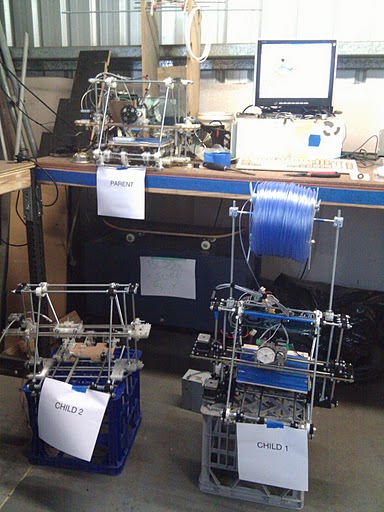
RepRap
What is RepRap? Introductory Lecture - Part 1 of 2
What is RepRap? Introductory Lecture - Part 2 of 2
Contour Crafting (CC) is a layered fabrication technology developed by Dr. Behrokh Khoshnevis of the University of Southern California. Contour Crafting technology has great potential for automating the construction of whole structures as well as sub-components. Using this process, a single house or a colony of houses, each with possibly a different design, may be automatically constructed in a single run, embedded in each house all the conduits for electrical, plumbing and air-conditioning.
Contour Crafting
Contour Crafting - Concrete-Jet Robot
We are fast approaching the END OF CAPITALISM! Long live TZM!
Ben Bernanke: Audit the Fed at The National Press Club
February 03, 2010 - Federal Reserve Chairman Ben Bernanke answers questions during a Q&A session at the National Press Club.
The question in this clip pertains to auditing the Federal Reserve.
Ben Bernanke: Audit the Fed at The National Press Club 02/03/11
The question in this clip pertains to auditing the Federal Reserve.
Ben Bernanke: Audit the Fed at The National Press Club 02/03/11
Wednesday, February 2, 2011
EXCLUSIVE INTERVIEW WITH RON PAUL: It's Going To Take A Crisis For Real Reform At The Fed

Congressman Ron Paul doesn't think we're going to get real reform at the Fed until there's a crisis that forces change in U.S. monetary policy.
"I think we'll end up with a real crisis and then they'll have to stop, think about it, and have a reform," of Fed policy, he said.
As new Chairman of the House Subcommittee on Monetary Policy, Congressman Paul sees informing the public of the Fed's actions as priority number one. He's being doing that for sometime, but now has a more substantial platform to speak from.
One of Congressman Paul's immediate aims is to challenge what he believes is a gross misunderstanding of Fed policy when it comes to unemployment. He intends to interview Former Fed board governors on the topic at the subcommittees first meeting on February 9th.
"This will give us a chance to make the point that just giving the Federal Reserve a mandate of high employment is not quite so simple and they're the culprits in creating the unemployment and they do nothing to prevent the unemployment," he said.
In the full interview, the Congressman's full thoughts on Fed Chairman Bernanke, on how inflation is being misrepresented in U.S. statistics, and what he expects to find if his audit the Fed bill is passed.
Continue reading - EXCLUSIVE INTERVIEW WITH RON PAUL: It's Going To Take A Crisis For Real Reform At The Fed
Subscribe to:
Posts (Atom)